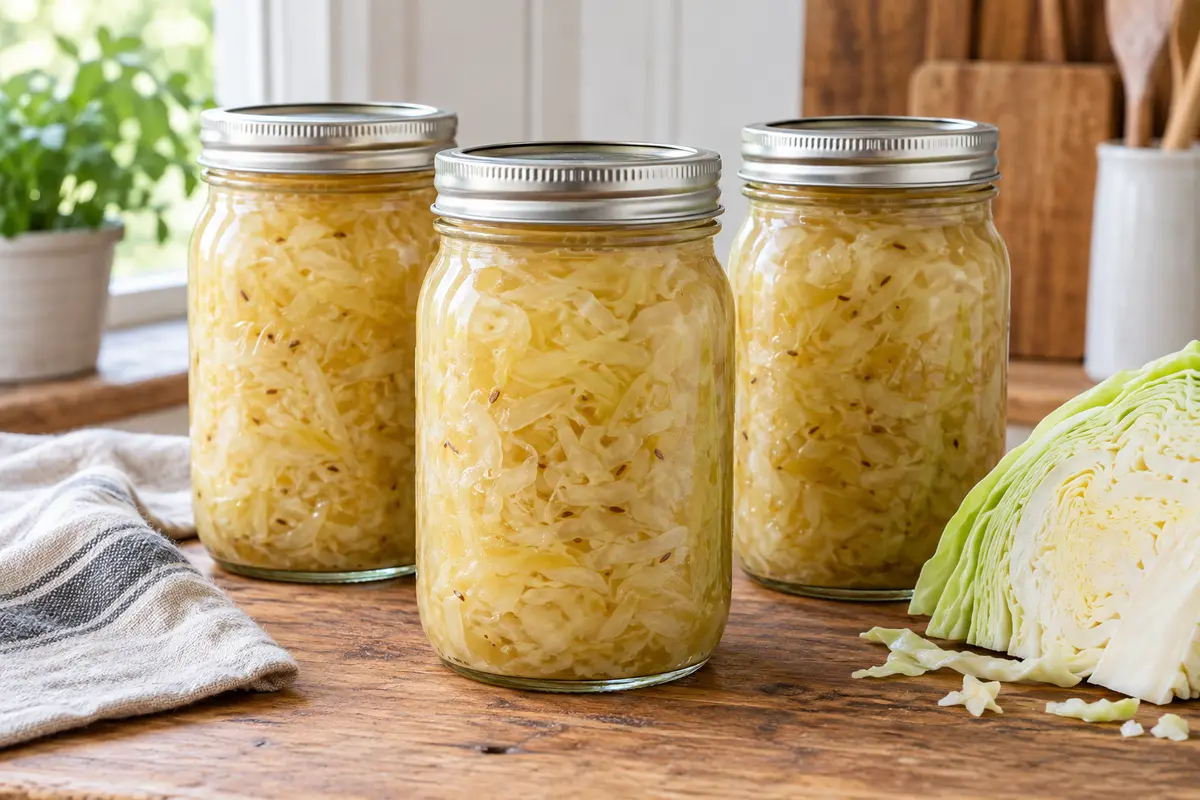
Sauerkraut — NCHFP
Pickle canning recipe published by USDA / National Center for Home Food Preservation (United States).
Ingredients
Ingredients
- 25 lbs cabbage
- 3/4 cup canning or pickling salt
Equipment
- 1 Boiling-water bath canner with rack
- 1 Large stainless or enamel preserving pot
- 1 Canning jars with two-piece lids
- 1 Headspace and bubble tool
Directions
Canning method
- Work with about 5 pounds of cabbage at a time. Discard outer leaves. Rinse heads under cold running water and drain. Cut heads in quarters and remove cores. Shred or slice to a thickness of a quarter.
- Put cabbage in a suitable fermentation container, see "Suitable Containers, Covers, and Weights for Fermenting Food," , and add 3 tablespoons of salt. Mix thoroughly, using clean hands. Pack firmly until salt draws juices from cabbage.
- Repeat shredding, salting, and packing until all cabbage is in the container. Be sure it is deep enough so that its rim is at least 4 or 5 inches above the cabbage. If juice does not cover cabbage, add boiled and cooled brine (1-1/2 tablespoons of salt per quart of water).
- Add plate and weights; cover container with a clean bath towel. Sauerkraut fermentation can take place under variable temperature and time combinations. For obtaining a good quality sauerkraut at home, the USDA recommendation is to store at 70 to 75 F while fermenting.
- At temperatures between 70 and 75 F, kraut will be fully fermented in about 3 to 4 weeks; at 60 to 65 F, fermentation may take 5 to 6 weeks. At temperatures lower than 60 F, kraut may not ferment. Above 75 F, kraut may become soft.
- If you weigh the cabbage down with a brine-filled bag, do not disturb the crock until normal fermentation is completed (when bubbling ceases). If you use jars as weight, you will have to check the kraut 2 to 3 times each week and remove scum if it forms.
- Fully fermented kraut may be kept tightly covered in the refrigerator for several months or it may be canned as follows: Hot pack Bring kraut and liquid slowly to a boil in a large kettle, stirring frequently.
- Remove from heat and fill jars rather firmly with kraut and juices, leaving 1/2-inch headspace. Raw pack Fill jars firmly with kraut and cover with juices, leaving 1/2-inch headspace. Adjust lids and process according to the recommendations in
- Processing: Process Hot, Pints, boiling-water canner, 0 - 1,000 ft - 10 minutes.
- Altitude-adjusted processing table: Table 1. Recommended process time for Sauerkraut in a boiling-water canner. / Process Time at Elevations of / Style of Pack - Jar Size - 0 - 1,000 ft - 1,001 - 3,000 ft - 3,001 - 6,000 ft - Above 6,000 ft / Hot - Pints - 10 min - 15 - 15 - 20 / Quarts - 15 - 20 - 20 - 25 / Raw - Pints - 20 - 25 - 30 - 35 / Quarts - 25 - 30 - 35 - 40
Keep this card open while you work. Ingredients and directions stay together on larger screens and stack clearly on phones.
Recipe Notes
Source: USDA / National Center for Home Food Preservation
Safety: Tested recipe from a USDA-aligned source, processed by boiling water bath. Follow the source method, times and headspace exactly, and adjust for your altitude.
Source: USDA / National Center for Home Food Preservation. USDA Complete Guide to Home Canning, 2015 revision. SAFETY: Tested recipe from a USDA-aligned source, processed by boiling water bath. Follow the source method, times and headspace exactly, and adjust for your altitude. Full method and quantities at the source: https://nchfp.uga.edu/papers/guide/GUIDE06_HomeCan_rev0715.pdf Guide PDF: https://nchfp.uga.edu/papers/guide/GUIDE06_HomeCan_rev0715.pdf Yield as published: About 9 quarts.