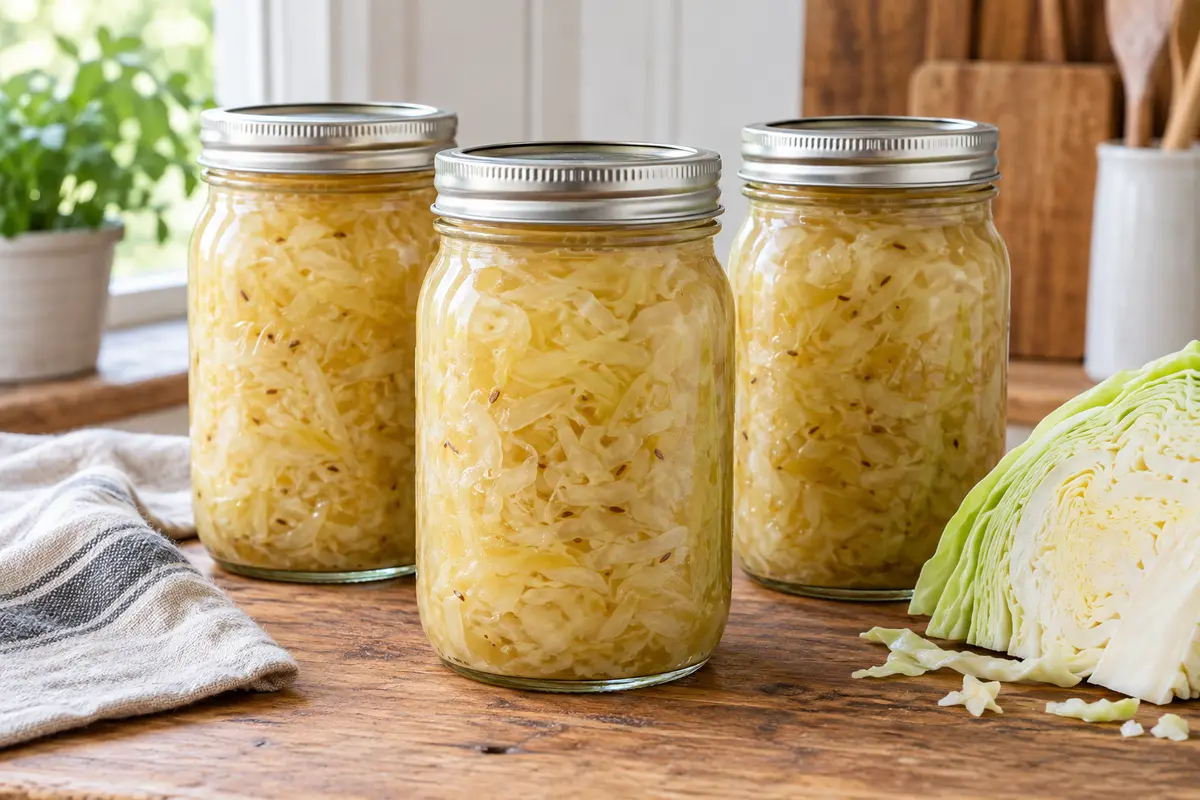
(function(){function place(){var root=document.currentScript&&document.currentScript.parentElement;if(!root)return;var card=root.querySelector(‘.wprm-recipe-snippet,.wprm-recipe-container’);var nav=root.querySelector(‘.recipe-quick-nav’);if(card&&nav&&card.nextElementSibling!==nav)root.insertBefore(card,nav);}if(document.readyState===’loading’)document.addEventListener(‘DOMContentLoaded’,place);else place();})();
Sauerkraut — NCHFP
Ingredients
- 25 lbs cabbage
- 3/4 cup canning or pickling salt
Equipment
- 1 Boiling-water bath canner with rack
- 1 Large stainless or enamel preserving pot
- 1 Canning jars with two-piece lids
- 1 Headspace and bubble tool
Directions
- Work with about 5 pounds of cabbage at a time. Discard outer leaves. Rinse heads under cold running water and drain. Cut heads in quarters and remove cores. Shred or slice to a thickness of a quarter.
- Put cabbage in a suitable fermentation container, see "Suitable Containers, Covers, and Weights for Fermenting Food," , and add 3 tablespoons of salt. Mix thoroughly, using clean hands. Pack firmly until salt draws juices from cabbage.
- Repeat shredding, salting, and packing until all cabbage is in the container. Be sure it is deep enough so that its rim is at least 4 or 5 inches above the cabbage. If juice does not cover cabbage, add boiled and cooled brine (1-1/2 tablespoons of salt per quart of water).
- Add plate and weights; cover container with a clean bath towel. Sauerkraut fermentation can take place under variable temperature and time combinations. For obtaining a good quality sauerkraut at home, the USDA recommendation is to store at 70 to 75 F while fermenting.
- At temperatures between 70 and 75 F, kraut will be fully fermented in about 3 to 4 weeks; at 60 to 65 F, fermentation may take 5 to 6 weeks. At temperatures lower than 60 F, kraut may not ferment. Above 75 F, kraut may become soft.
- If you weigh the cabbage down with a brine-filled bag, do not disturb the crock until normal fermentation is completed (when bubbling ceases). If you use jars as weight, you will have to check the kraut 2 to 3 times each week and remove scum if it forms.
- Fully fermented kraut may be kept tightly covered in the refrigerator for several months or it may be canned as follows: Hot pack Bring kraut and liquid slowly to a boil in a large kettle, stirring frequently.
- Remove from heat and fill jars rather firmly with kraut and juices, leaving 1/2-inch headspace. Raw pack Fill jars firmly with kraut and cover with juices, leaving 1/2-inch headspace. Adjust lids and process according to the recommendations in
- Processing: Process Hot, Pints, boiling-water canner, 0 - 1,000 ft - 10 minutes.
- Altitude-adjusted processing table: Table 1. Recommended process time for Sauerkraut in a boiling-water canner. / Process Time at Elevations of / Style of Pack - Jar Size - 0 - 1,000 ft - 1,001 - 3,000 ft - 3,001 - 6,000 ft - Above 6,000 ft / Hot - Pints - 10 min - 15 - 15 - 20 / Quarts - 15 - 20 - 20 - 25 / Raw - Pints - 20 - 25 - 30 - 35 / Quarts - 25 - 30 - 35 - 40
Recipe Notes
Private Notes
Questions or results?
Discuss this recipe with the canning community. Community comments do not replace the tested source or safety classification shown on this page.
Join the discussion
Please log in or create a free account to discuss this recipe. You will return here afterward.
Tried this recipe?
Share your results how it turned out.Safety classification
Tested NCHFP home-canning recipe.
Processing details
Method: Boiling water bath. Ferment salted cabbage completely, then choose the tested hot- or raw-pack schedule for pint or quart jars; 1/2-inch headspace; about 9 quarts.
Tested source
Preparation timeline
Shred and salt cabbage in 5-pound portions; pack under brine; ferment about 3–4 weeks at 70–75°F or 5–6 weeks at 60–65°F; then hot- or raw-pack and process.
Equipment
Food-safe fermentation container, plate and weights, thermometer, boiling-water canner, pint or quart jars, jar lifter, and funnel.
Visual method guide
- Prepare and measure ingredients exactly.
- Complete the tested cooking or fermentation stage.
- Fill, process by elevation, and cool undisturbed.
Safety essentials
Use 3 tablespoons canning or pickling salt per 5 pounds cabbage. Keep cabbage submerged; temperatures below 60°F may prevent fermentation and above 75°F may soften kraut.
About this recipe
Traditional sauerkraut produced by controlled lactic fermentation of cabbage and canning salt.
Before you begin
Work with about 5 pounds cabbage at a time. If natural juice does not cover cabbage, use the tested boiled-and-cooled brine.
Altitude/pressure schedule
| Elevation | Hot pints | Hot quarts | Raw pints | Raw quarts |
|---|---|---|---|---|
| 0–1,000 ft | 10 min | 15 min | 20 min | 25 min |
| 1,001–3,000 ft | 15 min | 20 min | 25 min | 30 min |
| 3,001–6,000 ft | 15 min | 20 min | 30 min | 35 min |
| Above 6,000 ft | 20 min | 25 min | 35 min | 40 min |
Serving suggestions
Serve warm or cold with sausages, pork, potatoes, sandwiches, or grain bowls.
FAQ
Can salt be reduced? No. The measured canning salt is essential to safe, successful fermentation.
Recipe context and comparison
The hot- and raw-pack canning schedules are distinct; select one complete row for jar size, pack, and elevation.
Troubleshooting
Normal fermentation ends when bubbling ceases. Remove surface scum when using jar weights; discard spoiled or abnormally soft product.
Source and provenance
Safety-critical values remain tied to the original NCHFP source.
Garden planning for this recipe
Plant, space, variety, zone, and timing estimates live on dedicated ingredient pages: