Recipe safety classification
Tested source recipe. Follow the cited formula, jar size, headspace, and complete altitude-adjusted process exactly.
Processing details
Use the complete source-specific process in the recipe card.
Publisher source
Preparation timeline
Read the complete card before starting and follow every source-specific step.
Equipment
Use the equipment stated in the recipe card.
Visual method guide
Prepare, fill, process or refrigerate, and store exactly as classified on this page.
Safety essentials
Do not alter safety-critical values.
About this recipe
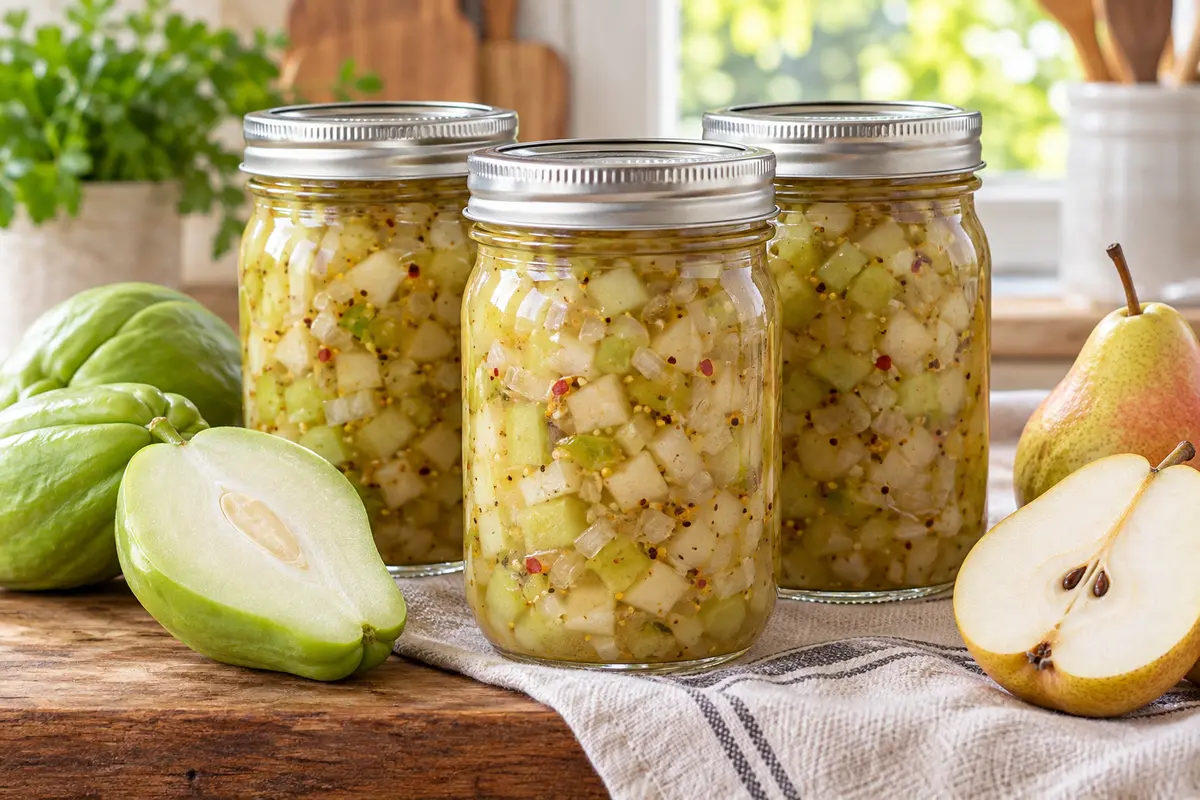
Chayote and Pear Relish — NCHFP is retained as a source-specific record.
Before you begin
Review the complete source and recipe card.
Altitude and processing schedule
Use the source schedule for your canner elevation.
Chayote and pear relish — NCHFP
Ingredients
- 3 1/2 cups peeled, cubed chayote (about 2 1/2 medium or 2 large, hard, crisp chayote)
- 3 1/2 cups peeled, cubed Seckel pears (about 6 to 7 raw Seckel pears)
- 2 cups chopped red bell pepper
- 2 cups chopped yellow bell pepper
- 3 cups finely chopped onion
- 2 Serrano peppers, finely chopped*
- 2 1/2 cups cider vinegar (5%)
- 1 1/2 cups water
- 1 cup white sugar
- 2 teaspoons canning salt
- 1 teaspoon ground allspice
- 1 teaspoon ground pumpkin pie spice
Equipment
- 1 Boiling-water bath canner with rack
- 1 Large stainless or enamel preserving pot
- 1 Canning jars with two-piece lids
- 1 Headspace and bubble tool
Directions
- Wash and rinse pint canning jars; keep hot until ready to use. Prepare lids according to the manufacturer’s directions.
- Wash, peel, and cut the chayote and pears into 1/2-inch cubes, discarding cores and seeds. Chop the onions and peppers.
- Combine vinegar, water, sugar, salt, and spices in a Dutch oven or large saucepot. Bring to a boil, stirring to dissolve the sugar. Add the chopped onions and peppers; return to a boil and boil for 2 minutes, stirring occasionally. Add the cubed chayote and pears; return to the boiling point and turn off the heat.
- Fill the hot solids into clean, hot pint jars to within 1 inch of the top. Cover with boiling-hot cooking liquid, leaving 1/2-inch headspace. Remove air bubbles and adjust the headspace if needed. Wipe the jar rims with a dampened clean paper towel; apply two-piece metal canning lids.
- Process hot-packed pint jars in a boiling-water canner for 15 minutes at 0–1,000 feet, 20 minutes at 1,001–6,000 feet, or 25 minutes above 6,000 feet.
- Let the jars cool undisturbed for 12–24 hours, then check the seals.
Recipe Notes
Private Notes
Questions or results?
Discuss this recipe with the canning community. Community comments do not replace the tested source or safety classification shown on this page.
Join the discussion
Please log in or create a free account to discuss this recipe. You will return here afterward.
Tried this recipe?
Share your results how it turned out.Serving and storage
Cool, verify seals, label, and store correctly.
Frequently asked questions
Follow the safety classification and cited source.
Recipe context
Do not combine this record with another preservation formula.
Troubleshooting
Discard food showing spoilage; never taste to determine safety.
Source & provenance
Garden planning for this recipe
Plant, space, variety, zone, and timing estimates live on dedicated ingredient pages: