Safety classification
Tested
Testing authority: National Center for Home Food Preservation
Safety reviewed: 09/21/2026
Processing details
Safety classification
Tested
Testing authority: National Center for Home Food Preservation
Safety reviewed: 09/21/2026
Processing details
Tested source
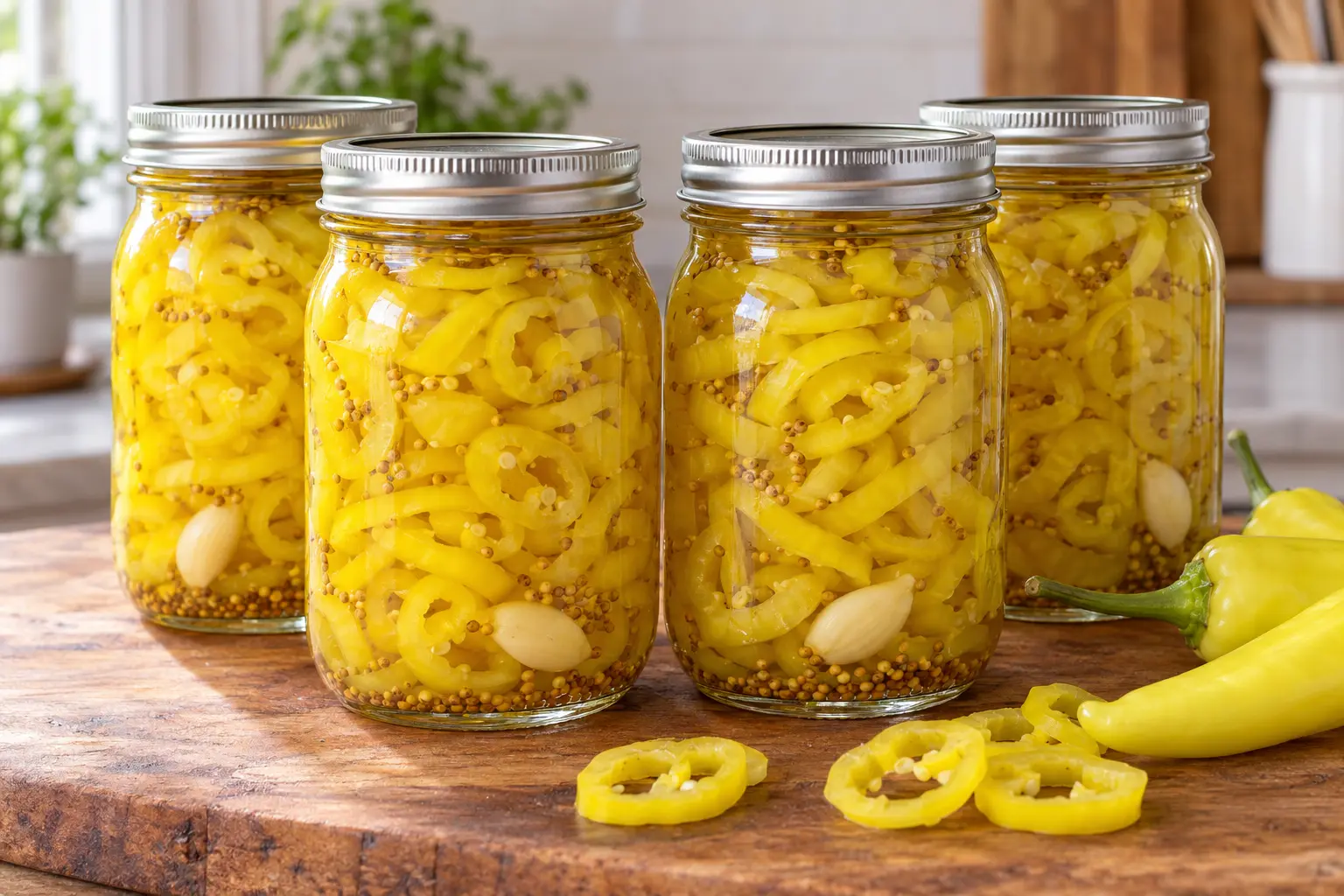
This page follows the National Center for Home Food Preservation recipe for Pickled Yellow Pepper Rings. Keep the tested ingredient proportions, pint jar size, 1/2-inch headspace, and altitude-adjusted processing schedule.
Preparation timeline
- Prepare: Set up the boiling-water canner and keep pint jars hot.
- Slice: Prepare yellow banana peppers as 1/4-inch rings.
- Pack: Raw-pack the pepper rings and measured spices into the hot jars.
- Fill: Add boiling pickling liquid, leaving 1/2-inch headspace.
- Process: Process for the altitude-adjusted time below.
- Cool: Leave jars undisturbed for 12 to 24 hours, then check seals.
Equipment
- Boiling-water canner with rack
- Four pint
canning jars, lids, and bands - Nonreactive saucepan
- Knife and cutting board
- Measuring cups and spoons
- Canning funnel and jar lifter
- Bubble remover or headspace tool
- Clean damp cloth and timer
Visual method guide
- Prepare jars and canner.
- Cut peppers into 1/4-inch rings.
- Raw-pack peppers and spices.
- Add boiling brine and leave 1/2-inch headspace.
- Process for your elevation.
- Cool and verify seals.
Safety essentials
- Use cider vinegar labeled 5% acidity.
- Do not dilute the vinegar or alter the tested pepper-vinegar-water proportions.
- Use pint jars only and leave 1/2-inch headspace.
- Keep the 1/4-inch ring preparation and apply the full altitude adjustment.
- Refrigerate any jar that does not seal.
About this recipe
This tested NCHFP recipe preserves yellow banana pepper rings in an acidified pickling liquid using boiling-water
Before you begin
Use fresh, sound peppers and measure every acidifying ingredient exactly. Prepare the complete
Safety classification
Tested
Testing authority: National Center for Home Food Preservation
Safety reviewed: 09/21/2026
Processing details
Pickled Yellow Pepper Rings — NCHFP
Ingredients
- 2 1/2 to 3 lb yellow banana peppers
- 5 cups cider vinegar 5% acidity
- 1 1/4 cups water
- 5 tsp canning salt
- 2 tbsp celery seed
- 4 tbsp mustard seed
Equipment
- Boiling-water canner
- Canning jars Four pint jars
Directions
- Prepare four hot pint jars and lids. Wash peppers, remove stem ends, and slice into 1/4-inch rings.
- Combine cider vinegar, water, and salt; bring to a boil.
- Place 1/2 tablespoon celery seed and 1 tablespoon mustard seed in each hot pint jar. Fill with pepper rings.
- Cover with boiling pickling liquid, leaving 1/2-inch headspace. Remove bubbles, adjust headspace, wipe rims, and apply lids.
- Process pints for 10 minutes at 0–1,000 ft, 15 minutes at 1,001–6,000 ft, or 20 minutes above 6,000 ft. Cool 12 to 24 hours, check seals, and shake before serving to disperse spices.
Recipe Notes
Private Notes
Questions or results?
Discuss this recipe with the canning community. Community comments do not replace the tested source or safety classification shown on this page.
Join the discussion
Please log in or create a free account to discuss this recipe. You will return here afterward.
Tried this recipe?
Share your results how it turned out.Serving suggestions
Drain and serve the pepper rings as a tangy condiment for sandwiches, burgers, beans, or composed salads. Shake the sealed jar before opening to redistribute the spices.
Frequently asked questions
Can I use larger jars?
No. The tested process is for pint jars only.
Can I reduce the vinegar?
No. Use vinegar labeled 5% acidity and keep the tested proportions.
What if a jar does not seal?
Refrigerate it promptly or reprocess within 24 hours with a new lid and the full tested process.
Recipe context
Do not combine this record with another preservation formula.
Troubleshooting
Distribute the measured mustard and celery seed among jars as directed. If the spices settle, shake the sealed jar before serving. Refrigerate any unsealed jar promptly or reprocess within 24 hours using a new lid and the full tested process.
Source & provenance
Typical canning season
Season: Summer, Fall
Months: July, August, September, October
How much of the main ingredient should I grow?
8–18 lb of Peppers per person per year
This is an annual planning range that includes preserving and typical fresh use. Plant, row-foot, and square-foot estimates are shown only when compatible cited yield or spacing data is available.
Garden yields vary by cultivar, climate, soil, pests, and care. Always measure the exact prepared ingredient amount required by the tested canning recipe.