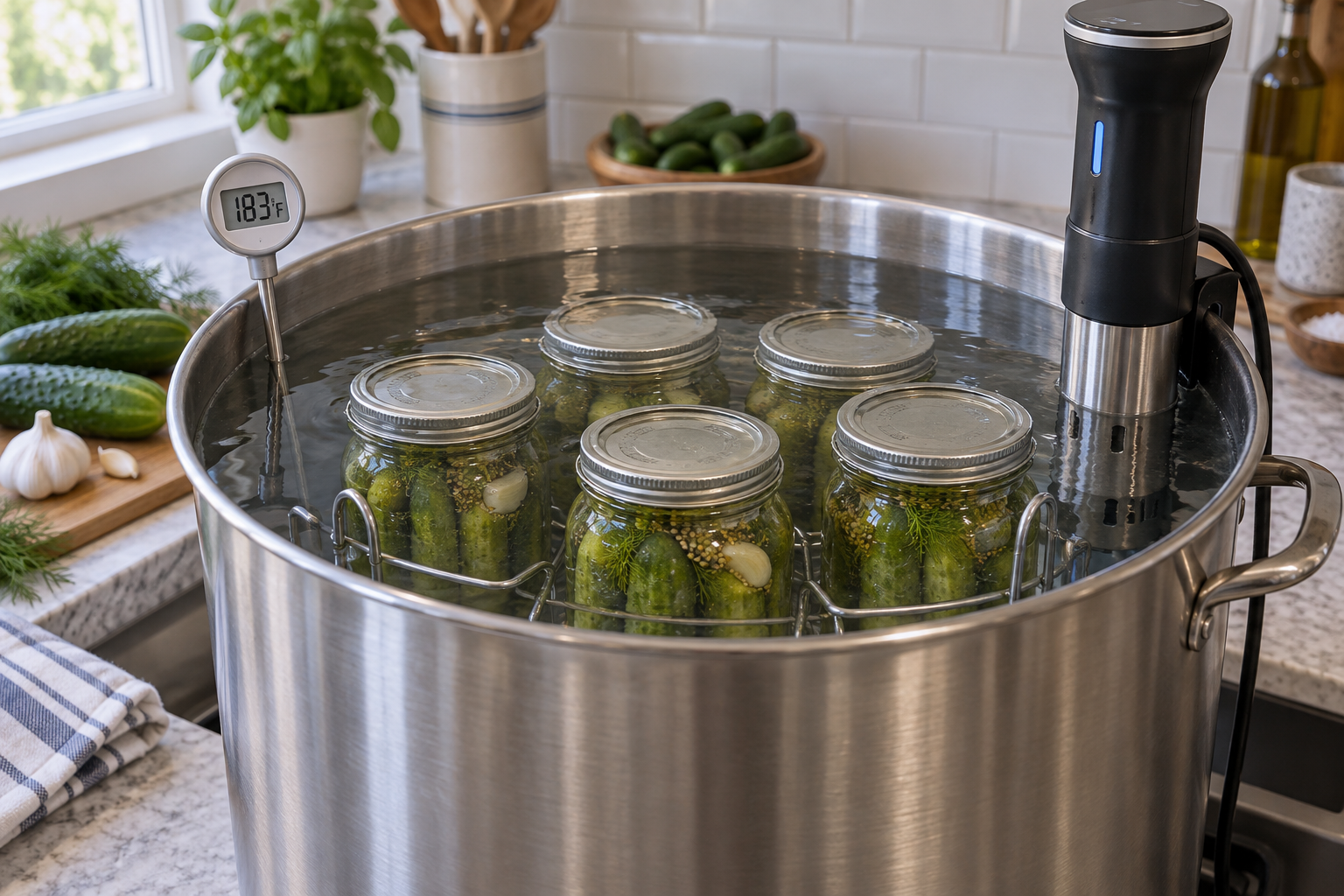
Short answer: A sous vide immersion circulator can help hold a water bath in the narrow 180–185°F (82.2–85°C) range used by the NCHFP low-temperature pasteurization treatment. But the circulator does not make an untested pickle recipe safe, and NCHFP does not specifically certify sous vide machines as home canners. Use this approach only with a research-tested recipe that explicitly permits the 30-minute low-temperature treatment.
Critical safety boundary
Do not use this guide for ordinary low-acid vegetables, meat, seafood, soups, dairy, eggs, plain tomatoes, oil-packed foods, improvised pickles, or any recipe that lists only boiling-water or pressure processing. Low-temperature pasteurization is not “low-temperature
What is low-temperature pasteurization canning ?
NCHFP’s treatment places properly filled and closed jars in warm water, raises the surrounding water to 180–185°F, and holds it there for 30 minutes. The water must remain at least 180°F for the entire timed period and stand 1 inch above the jars. Going above 185°F can unnecessarily soften pickles. NCHFP says to use the treatment only when the individual recipe indicates it.
The advantage is texture: a precisely managed sub-boiling bath can produce a firmer pickle than a rolling-boil process. The disadvantage is a very small operating window. A bath that runs cool or has cold zones does not follow the tested process.
Can you use a sous vide immersion circulator?
As a conservative equipment adaptation, yes—only as a water-temperature controller for an already validated recipe. This is an inference from the NCHFP time-and-temperature process, not a separate USDA/NCHFP endorsement of immersion circulators. Your setup still has to behave like the prescribed canner:
- Use a deep, heat-safe vessel with a jar rack.
- Keep water at least 1 inch above every lid for the entire process.
- Do not let jars touch the circulator, its heating element, intake, or outlet.
- Leave enough space for unrestricted circulation around all jars.
- Confirm the temperature with a separate, calibrated thermometer—ideally checking more than one point in the bath.
- Follow the circulator manufacturer’s water-depth, vessel, sanitation, and operating restrictions.
- Start the 30-minute timer only after the whole bath is within 180–185°F.
If your circulator or container cannot safely accommodate jars under 1 inch of water without blocking flow or exceeding the device’s maximum fill line, use a conventional canner and thermometer instead.
Exact 180–185°F workflow
- Choose an eligible recipe. It must explicitly state that low-temperature pasteurization may replace the boiling-water schedule. Do not infer permission from acidity alone.
- Prepare the food exactly. Preserve every specified food-to-vinegar-to-water ratio, 5% vinegar requirement, cucumber size, soaking or fermentation step, jar size, and headspace.
- Prepare the bath. Put a rack in the vessel and begin with water around 120–140°F. Preheat the circulator separately enough to avoid thermal shock, while respecting its manufacturer instructions.
- Load the jars. Set hot, filled jars upright on the rack. Add hot water until it is 1 inch above the lids.
- Verify the bath. Allow the water to circulate. Check near the circulator and at the coolest likely location with an independent thermometer.
- Time precisely. When all checked locations are at least 180°F and no location exceeds 185°F, start 30 minutes.
- Correct any temperature loss. If the bath falls below 180°F, the conservative response is to bring the entire bath back into range and restart the full 30-minute timing.
- Cool and check seals. Lift jars straight up, keep them upright, and cool undisturbed for 12–24 hours. Check seals, remove screw bands, label, and store in a cool, dark, dry place. Refrigerate any unsealed jar promptly.
Equipment checklist
- Research-tested eligible recipe
- Standard home-canning jars, new flat lids, and compatible screw bands
- Deep vessel plus rack
- Immersion circulator permitted by its manufacturer for the proposed setup
- Independent calibrated thermometer
- Jar lifter,
canning funnel, headspace tool, clean towels, and timer
The complete validated recipe directory
After reviewing current NCHFP/USDA material and university Extension guidance, these are the six recipes I found that explicitly authorize the 180–185°F, 30-minute treatment. All six now have dedicated recipe pages on this site.
| Recipe | Style | Status |
|---|---|---|
| Quick Fresh-Pack Dill Pickles | Acidified, fresh-pack dill | Tested; low-temp option explicit |
| Bread-and-Butter Pickles | Sweet-and-sour slices | Tested; low-temp option explicit |
| Sweet Gherkin Pickles | Multi-day whole gherkins | Tested; low-temp option explicit |
| 14-Day Sweet Pickles | Cured sweet pickles | Tested; low-temp option explicit |
| Quick Sweet Pickles | Quick-process slices or strips | Tested; low-temp option explicit |
| Fermented Dill Pickles | Fully fermented, then canned | Tested; low-temp option explicit |
Worldwide recipe audit: what counts—and what does not
Pickled vegetables are global, but “sous vide pickles” describes several different processes. Korean jangajji, Japanese tsukemono, German-style pickles, Scandinavian pickles, Indian achar, Italian sottaceti, and many other traditions may be delicious, but a cultural recipe name does not establish a tested shelf-stable thermal process.
| Method found worldwide | Storage category | Can it use this shelf-stable process? |
|---|---|---|
| Research-tested recipe that explicitly names 180–185°F for 30 minutes | Shelf-stable after a successful seal and exact processing | Yes, for that recipe only |
| Sous vide vegetables in a vacuum bag | Refrigerated or immediately served | No; this is cooking, not |
| Quick refrigerator pickles in jars | Refrigerated | No; keep cold for the recipe’s stated life |
| Naturally fermented vegetables | Actively fermenting or refrigerated unless a tested | Only the linked NCHFP dill recipe above has the validated low-temp finish in this directory |
| Traditional or blog recipe with an improvised sous vide jar process | Unvalidated for room-temperature storage | No; refrigerate rather than presenting it as shelf-stable |
| Tested pickle recipe that specifies boiling-water processing but does not offer low-temperature pasteurization | Shelf-stable only after its stated boiling-water process | No substitution |
I did not convert unvalidated international recipes into shelf-stable
Why vinegar strength matters
Use the vinegar acidity stated by the tested recipe. The recipes in this directory call for vinegar labeled 5% acidity. Do not dilute it beyond the listed formula, substitute a lower-acidity vinegar, enlarge vegetable pieces, increase vegetable quantity, or alter jar size. Flavor spices may sometimes be adjustable, but the acid, water, food, salt, sugar, preparation, and processing variables must remain as tested.
Troubleshooting
The bath reached 186°F
Reduce heat promptly. The principal concern identified by NCHFP is unnecessary softening. Keep the bath within 180–185°F for the process.
The bath dropped to 179°F
Restore the whole bath to the validated range and restart the 30-minute timer. A partial under-temperature hold is not the published treatment.
One jar is partly above water
Stop and correct the water depth. Every jar must stay covered by 1 inch.
A lid did not seal
Refrigerate the jar and use it promptly, or reprocess within 24 hours using a new lid and the original recipe’s complete directions if product quality permits.
Can I set the circulator to exactly 180°F?
A set point is not proof of bath temperature. Small measurement errors could put the bath below the minimum. Use an independently verified setup that keeps every measured point inside 180–185°F without overshooting.
Frequently asked questions
Is sous vide canning approved by the USDA?
No blanket “sous vide
Can I process pickled carrots, peppers, onions, beets, okra, or mixed vegetables at 180°F?
Not unless the exact research-tested recipe explicitly offers that treatment. The NCHFP recipes for many vegetable pickles specify boiling-water processing and should be processed that way.
Does a measured pH below 4.6 make any recipe safe for this method?
No. A finished pH reading does not replace a tested formulation and heat process; product thickness, particle size, acid penetration, preparation, container, and heat delivery also matter.
Can I use quart jars?
Only where the individual recipe allows quarts. Do not increase jar size on your own.
Are 4% vinegars interchangeable with 5% vinegar?
No. Use the acidity specified in the tested recipe; these recipes call for 5% vinegar.
Authoritative references
- NCHFP: Low-Temperature Pasteurization Treatment
- NCHFP: Quick Fresh-Pack Dill Pickles
- NCHFP: Bread-and-Butter Pickles
- NCHFP: Sweet Gherkin Pickles
- NCHFP: 14-Day Sweet Pickles
- NCHFP: Quick Sweet Pickles
- NCHFP: Fermented Dill Pickles
Editorial standard: Safety classifications were checked against the cited recipe pages. Consumer blog recipes were not promoted as shelf-stable when no comparable authority supplied an exact validated process.