Recipe safety classification
Tested source recipe. Follow the cited formula, jar size, headspace, and complete altitude-adjusted process exactly.
Processing details
Use the complete source-specific process in the recipe card.
Publisher source
Preparation timeline
Read the complete card before starting and follow every source-specific step.
Equipment
Use the equipment stated in the recipe card.
Visual method guide
Prepare, fill, process or refrigerate, and store exactly as classified on this page.
Safety essentials
Do not alter safety-critical values.
About this recipe
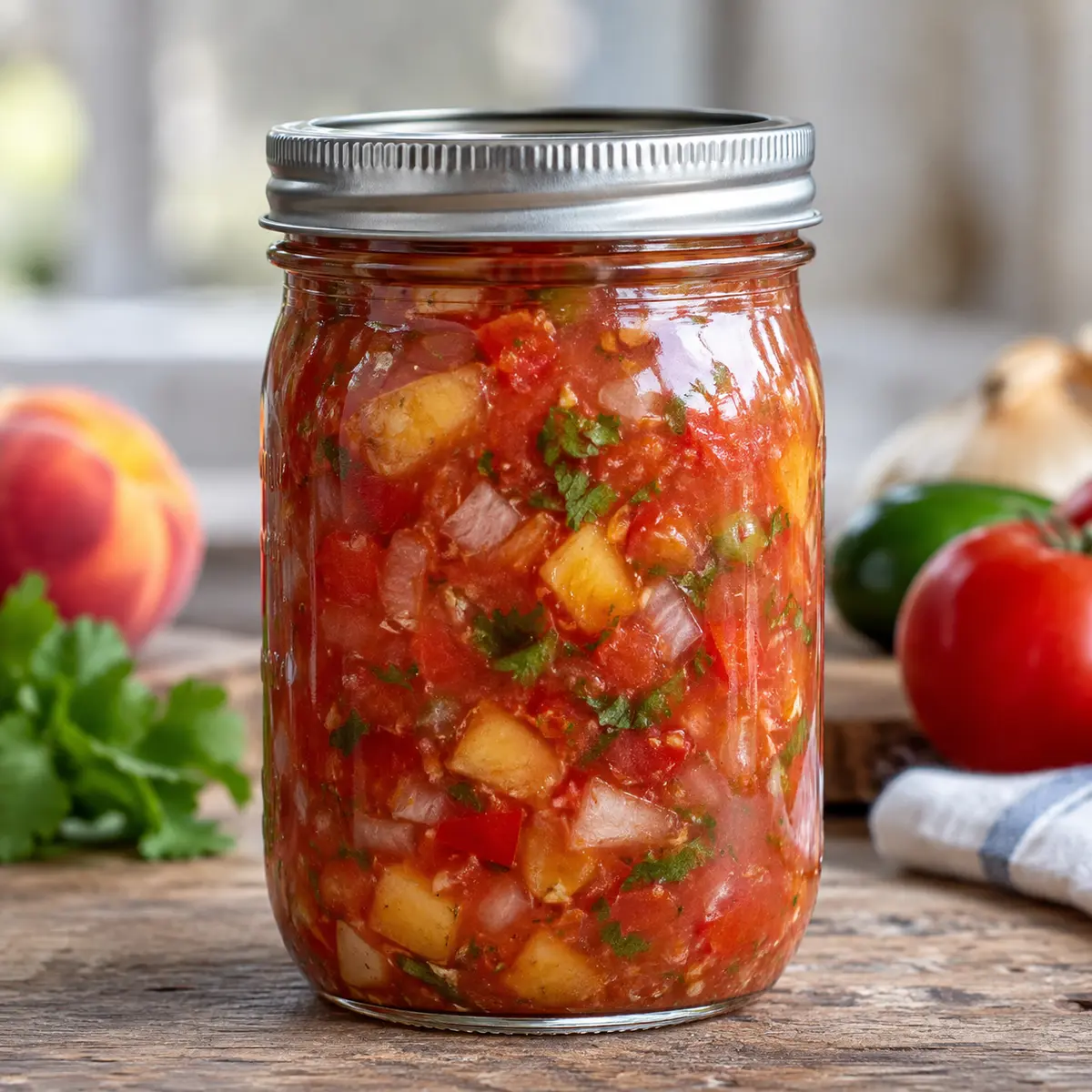
Easy Orchard Salsa — Bernardin is retained as a source-specific record.
Before you begin
Review the complete source and recipe card.
Altitude and processing schedule
Use the source schedule for your canner elevation.
Easy Orchard Salsa — Bernardin
Ingredients
- 10 cups (2.5 L) coarsely chopped, pitted, peeled peaches, about 14 medium
- 5 cups (1.25 L) chopped, peeled, cored pears, about 7 medium
- Zest and juice of 4 large limes
- 4 tbsp (60 ml) liquid honey
- 1 cup (250 ml) Fiesta Salsa Mix
Equipment
- 1 Boiling-water bath canner with rack
- 1 Large stainless or enamel preserving pot
- 1 Canning jars with two-piece lids
- 1 Headspace and bubble tool
Directions
- Place 6 clean 500 ml mason jars on a rack in a boiling watercanner; cover jars with water and heat to a simmer (180°F/82°C). Setscrew bands aside. Keep jars hot until ready to use. Preheating Bernardin® lids is not advised.
- The sealing compound used for our home canning lids performs better at room temperature than it does pre-heated in simmering water (180°F). Simply wash lids in hot, soapy water, dry, and set aside until needed.
- Preheating can lead to less vacuum being achieved during water bath canning, and to buckle failures during pressure canning. Peel, pit or core, chop & measure peaches andpears individually; combine in a large, deep stainless steel saucepan.Grate zest from limes and squeeze juice.
- Add grated zest, 1/2 cup (125 ml)lime juice, honey and Salsa Mix to fruit. Over medium-high heat, bringmixture to a boil, stirring frequently. Reduce heat and simmer stirringconstantly, just until mixture is heated through.
- REFRIGERATED: Ladle hot salsa into six hot 500 mljars or two 1.5 L mason jars; apply closures. Cool 30 minutes andrefrigerate up to 3 weeks or freeze in straight-sided jars or containersup to 1 year.
- SHELF-STABLE: Ladle hot salsa into a hot 500 ml mason jar to within 1/2 inch (1 cm) of top of jar (headspace). Using nonmetallic utensil, remove air bubbles and adjust headspace, if required, by adding more salsa. Wipe jar rim removing any food residue.
- Screw band down until resistance is met, then increase to fingertip tight. Return filled jar to rack in canner. Repeat for remaining salsa. When canner is filled, ensure that all jars are covered by at least one inch (2.5 cm) of water.
- Cover canner and bring water to full rolling boil before starting to count processing time. At altitudes up to 1000 ft (305 m), process - boil filled jars -250 ml jars 15 minutes *; 500 ml jars 20 minutes *.
- When processing time is complete, remove canner lid, wait 5 minutes, then remove jars without tilting and place them upright on a protected work surface. Cool upright, undisturbed 24 hours; DO NOT RETIGHTEN screw bands. After cooling check jar seals.
- Sealed discs curve downward and do not move when pressed. Remove screw bands; wipe and dry bands and jars. Store screw bands separately or replace loosely on jars, as desired. Label and store jars in a cool, dark place. For best quality, use home canned foods within one year.
- Makes about 5 to 6 x 500 ml depending on desired consistency (cooking longer will reduce the amount of salsa, if thicker consistency is desired)
- Processing: At altitudes up to 1000 ft (305 m), process - boil filled jars -250 ml jars 15 minutes - 15 minutes.
- Altitude-adjusted processing table: At altitudes up to 1000 ft (305 m), process - boil filled jars -250 ml jars 15 minutes
Recipe Notes
Private Notes
Tried this recipe?
Share your results how it turned out.Serving and storage
Cool, verify seals, label, and store correctly.
Frequently asked questions
Follow the safety classification and cited source.
Recipe context
Do not combine this record with another preservation formula.
Troubleshooting
Discard food showing spoilage; never taste to determine safety.
Source & provenance
Garden planning for this recipe
Plant, space, variety, zone, and timing estimates live on dedicated ingredient pages: