Recipe safety classification
Tested source recipe. Follow the cited formula, jar size, headspace, and complete altitude-adjusted process exactly.
Processing details
Use the complete source-specific process in the recipe card.
Publisher source
Preparation timeline
Read the complete card before starting and follow every source-specific step.
Equipment
Use the equipment stated in the recipe card.
Visual method guide
Prepare, fill, process or refrigerate, and store exactly as classified on this page.
Safety essentials
Do not alter safety-critical values.
About this recipe
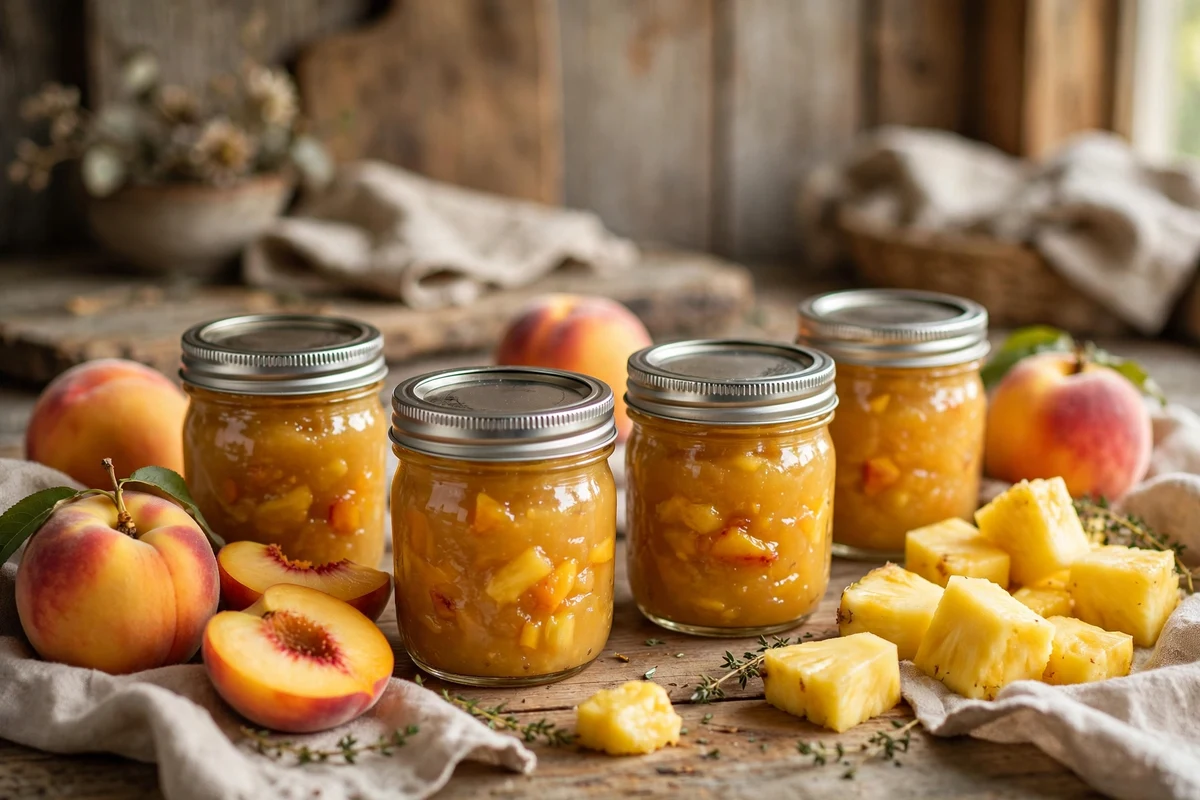
Peach-pineapple spread — NCHFP is retained as a source-specific record.
Before you begin
Review the complete source and recipe card.
Altitude and processing schedule
Use the source schedule for your canner elevation.
Peach-pineapple spread — NCHFP
Ingredients
- 4 cups drained peach pulp (procedure as below)
- 2 cups drained unsweetened crushed pineapple
- 1/4 cup bottled lemon juice
- 2 cups sugar (optional)
Equipment
- 1 Boiling-water bath canner with rack
- 1 Large stainless or enamel preserving pot
- 1 Canning jars with two-piece lids
- 1 Headspace and bubble tool
- 1 Jelly or candy thermometer
Directions
- Thoroughly wash 4 to 6 pounds of firm, ripe peaches. Drain well. Peel and remove pits. Grind fruit flesh with a medium or coarse blade, or crush with a fork; do not use a blender.
- Place ground or crushed fruit in a 2-quart saucepan. Heat slowly to release juice, stirring constantly, until fruit is tender. Place cooked fruit in a jelly bag or a strainer lined with four layers of cheesecloth. Allow juice to drip for about 15 minutes. Save the juice for jelly or other uses.
- Measure 4 cups of drained fruit pulp. Combine the pulp, pineapple, and bottled lemon juice in a 4-quart saucepan. Add up to 2 cups of sugar, if desired, and mix well. Heat and boil gently for 10 to 15 minutes, stirring enough to prevent sticking.
- Fill jars quickly, leaving 1/4-inch headspace. Adjust lids.
- Processing: Process hot half-pints for 15 minutes at 0–1,000 feet in a boiling-water canner. For pints and higher elevations, use the complete altitude-adjusted table in the next step.
- Altitude-adjusted processing table: Hot pack — Half-pints: 15 minutes at 0–1,000 ft; 20 minutes at 1,001–3,000 ft; 20 minutes at 3,001–6,000 ft; 25 minutes above 6,000 ft. Pints: 20 minutes at 0–1,000 ft; 25 minutes at 1,001–3,000 ft; 30 minutes at 3,001–6,000 ft; 35 minutes above 6,000 ft.
Recipe Notes
Private Notes
Tried this recipe?
Share your results how it turned out.Serving and storage
Cool, verify seals, label, and store correctly.
Frequently asked questions
Follow the safety classification and cited source.
Recipe context
Do not combine this record with another preservation formula.
Troubleshooting
Discard food showing spoilage; never taste to determine safety.