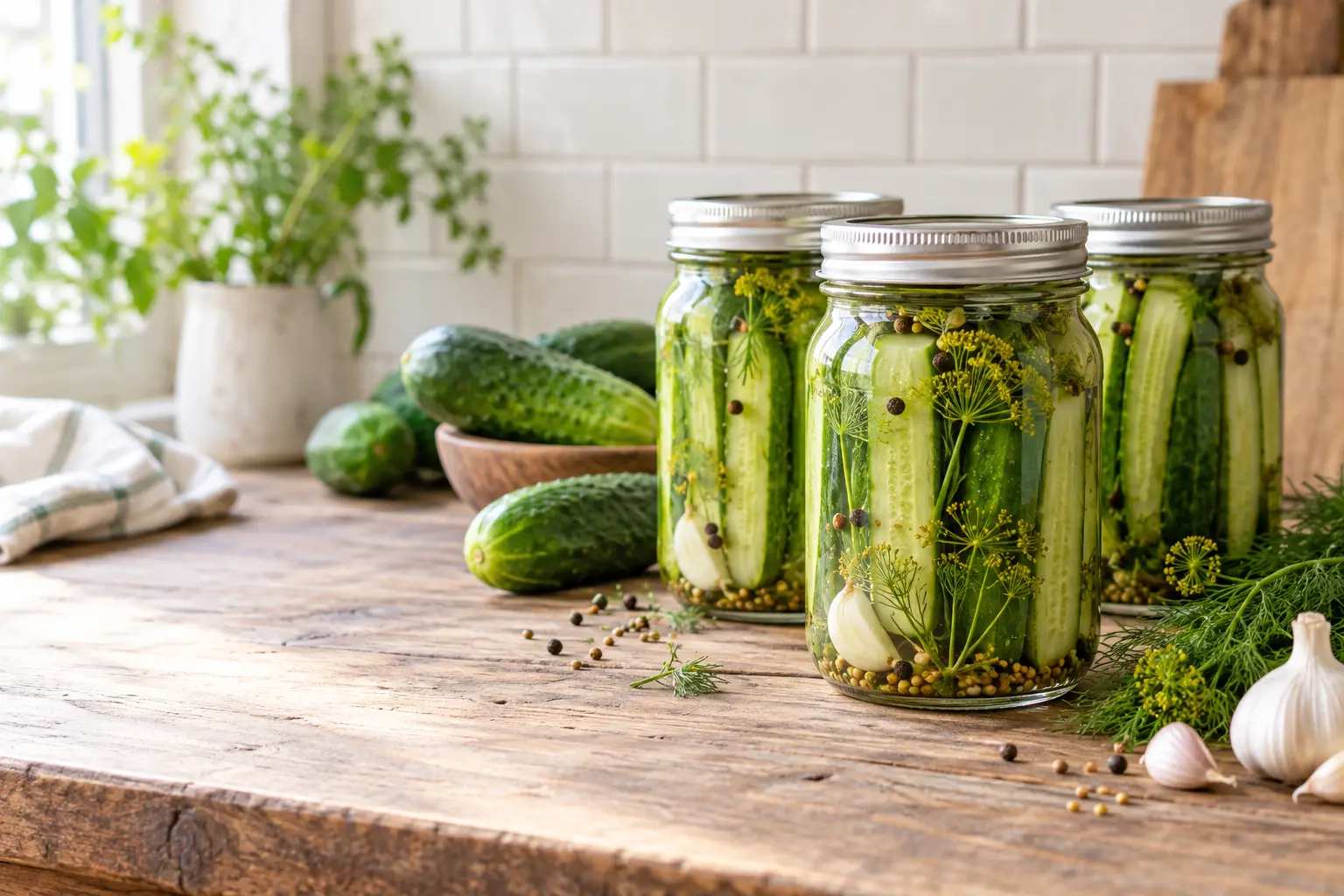
Dill pickle canning safety at a glance
| Requirement | Tested specification |
|---|---|
| Vinegar | Commercial vinegar labeled 5% acidity |
| Jar sizes | Pints or quarts |
| Headspace | ½ inch |
| Yield | 7–9 pints |
| Preparation | 12-hour tested salt soak |
Processing details
Method: Boiling-water
Tested source
Tested recipe source: National Center for Home Food Preservation (NCHFP)
Quick fresh-pack dill pickle timeline
- Prepare: Wash cucumbers, remove 1/16 inch from blossom ends, and leave ¼ inch of stem.
- Salt soak: Cover with the tested salt-water mixture for 12 hours, then drain.
- Fill: Make the boiling 5% vinegar brine, pack jars, add mustard and dill, and leave ½-inch headspace.
- Process: Use the boiling-water schedule or the source-authorized low-temperature pasteurization treatment.
Equipment for this recipe
Affiliate disclosure: Equipment links may be affiliate links; commissions do not influence safety guidance.
- Boiling-water canner with rack
- Pint or quart jars with lids and bands
- Large nonreactive brining container and saucepan
- Clean white cloth or spice bag,
canning funnel, jar lifter, and headspace tool - Accurate thermometer and suitable canner only when using the authorized low-temperature treatment
Visual guide to the tested method
- Trim blossom ends and soak cucumbers in the tested salt solution for 12 hours.
- Drain and prepare the 5% vinegar brine with the remaining salt, sugar, and spice bag.
- Pack jars with cucumbers, mustard seed, and dill.
- Cover with boiling brine and leave ½-inch headspace.
- Process with one complete authorized method.
The written NCHFP directions and WPRM card remain authoritative.
Safety essentials
Safety boundary: Do not reduce the vinegar, increase the water, change the food-to-acid proportions, or apply the low-temperature treatment to another recipe.
What are quick fresh-pack dill pickles?
These tested cucumber pickles are salt-soaked, packed with dill and mustard seed, covered with a 5% vinegar brine, and processed for shelf stability.
Before you begin
- Use 3- to 5-inch pickling cucumbers.
- Remove the blossom end to reduce softening enzymes.
- Use
canning or pickling salt and 5% acidity vinegar. - Choose one complete authorized processing method.
Altitude-adjusted boiling-water processing
| Jar | 0–1,000 ft | 1,001–6,000 ft | Above 6,000 ft |
|---|---|---|---|
| Pints | 10 min | 15 min | 20 min |
| Quarts | 15 min | 20 min | 25 min |
Authorized alternative: This specific NCHFP recipe also permits low-temperature pasteurization. Follow the linked NCHFP treatment exactly and consult the low-temperature pasteurization guide.
Quick Fresh-Pack Dill Pickles — NCHFP
Ingredients
- 8 lb pickling cucumbers 3- to 5-inch
- 2 gal water for brining
- 1 1/4 cups canning or pickling salt divided
- 1 1/2 qt vinegar 5% acidity
- 1/4 cup sugar
- 2 qt water for pickling liquid
- 2 Tbsp whole mixed pickling spice
- 3 Tbsp whole mustard seed about
- 14 heads fresh dill or 4 1/2 Tbsp dill seed
Equipment
- 1 Boiling-water canner For processing filled jars.
- 7–9 Canning jars Pints or quarts as allowed by the source.
- 7–9 Two-piece canning lids Prepare according to manufacturer directions.
Directions
- Wash cucumbers; remove a 1/16-inch slice from the blossom end and leave about 1/4 inch of stem.
- Dissolve 3/4 cup salt in 2 gallons water, pour over cucumbers, let stand 12 hours, then drain.
- Combine 5% vinegar, remaining 1/2 cup salt, sugar, and 2 quarts water. Add mixed pickling spice in a clean cloth and heat to boiling.
- Fill jars with cucumbers; add mustard seed and dill as directed by the source.
- Cover with boiling pickling solution, leaving 1/2-inch headspace. Adjust lids and process by altitude.
Recipe Notes
Private Notes
Questions or results?
Discuss this recipe with the canning community. Community comments do not replace the tested source or safety classification shown on this page.
Join the discussion
Please log in or create a free account to discuss this recipe. You will return here afterward.
Tried this recipe?
Share your results how it turned out.How to serve dill pickles
Serve chilled with sandwiches, burgers, salads, or snack boards. Refrigerate after opening.
Dill pickle canning questions
Can I reduce the vinegar?
No. Keep the tested 5% vinegar, water, salt, and cucumber proportions.
Why remove the blossom end?
The source directs removing a 1/16-inch slice because the blossom end can contribute to softening.
Can I use low-temperature pasteurization?
Yes, for this specific recipe, when the complete NCHFP treatment is followed accurately.
Fresh-pack pickles versus fermented dills
This is an acidified fresh-pack recipe, not a fermented pickle. Fermented dills use a different brine, fermentation period, and tested process.
Dill pickle troubleshooting
Why are the pickles soft?
Use fresh cucumbers, remove blossom ends, maintain the tested brine, and avoid temperatures above the authorized range when using low-temperature pasteurization.
Why is there not enough brine?
Use the exact tested quantities and pack jars without altering the vinegar-to-water ratio.
What if a jar does not seal?
Refrigerate and use promptly or follow an authoritative reprocessing procedure within the permitted time.
Source & provenance
Garden planning for this recipe
Plant, space, variety, zone, and timing estimates live on dedicated ingredient pages:
Typical canning season
Season: Summer, Fall
Months: July, August, September
How much of the main ingredient should I grow?
12–25 lb of Pickling cucumbers per person per year
This is an annual planning range that includes preserving and typical fresh use. Plant, row-foot, and square-foot estimates are shown only when compatible cited yield or spacing data is available.
Garden yields vary by cultivar, climate, soil, pests, and care. Always measure the exact prepared ingredient amount required by the tested canning recipe.