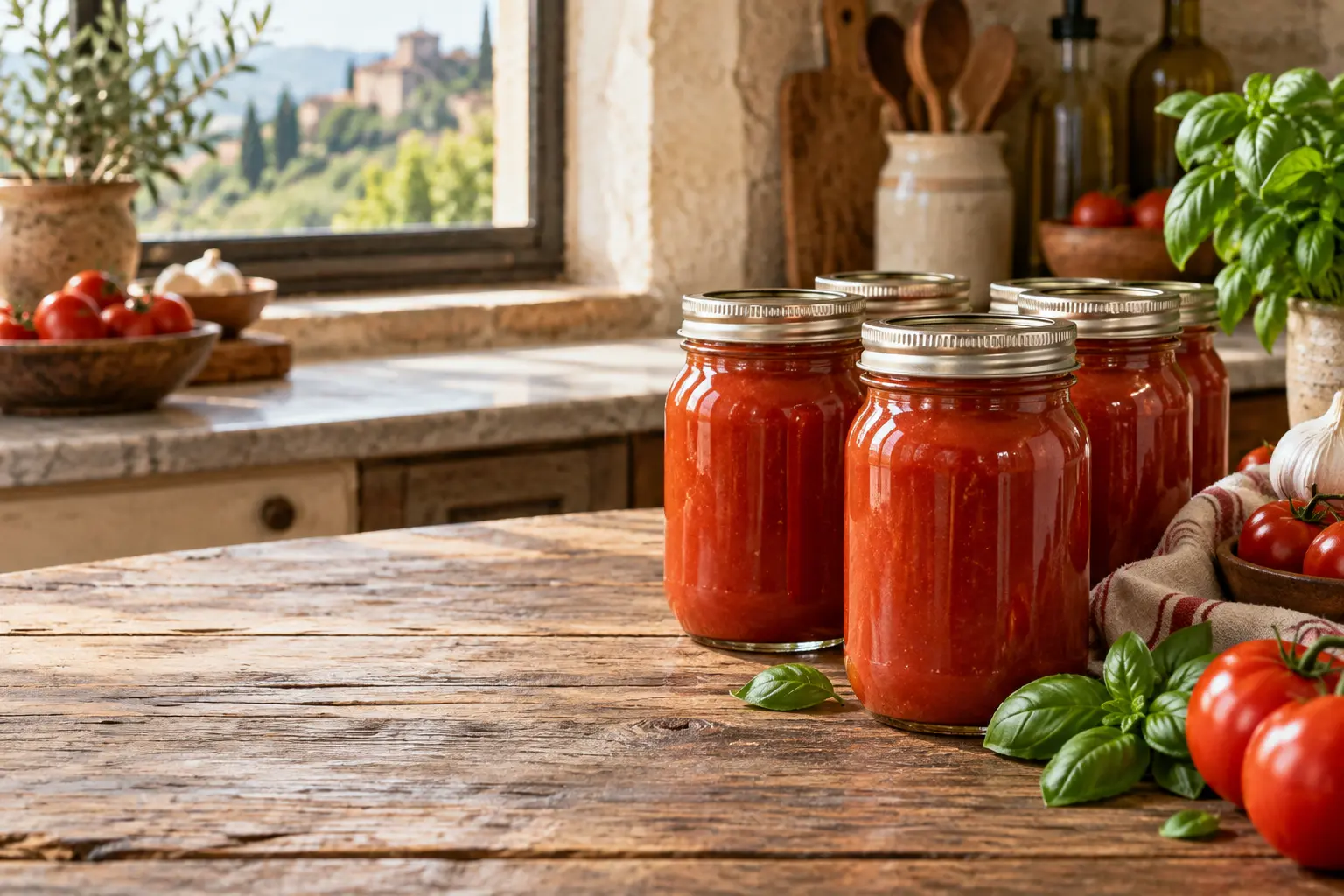
Tomato sauce canning safety at a glance
| Requirement | Tested specification |
|---|---|
| Pack | Hot pack |
| Jar sizes | Pints or quarts |
| Headspace | ¼ inch |
| Acidification | Per pint: 1 Tbsp bottled lemon juice or ¼ tsp citric acid; per quart: 2 Tbsp bottled lemon juice or ½ tsp citric acid |
| Salt | Optional |
Processing details
Methods: Boiling-water or pressure
Tested source
Tested recipe source: National Center for Home Food Preservation (NCHFP)
Tomato sauce timeline at a glance
- Prepare: Prepare and press tomatoes as for tomato juice.
- Reduce: Simmer until reduced by about one-third for thin sauce or one-half for thick sauce.
- Acidify and fill: Add bottled lemon juice or citric acid to each jar, add optional salt, fill hot, and leave ¼-inch headspace.
- Process: Use one complete NCHFP boiling-water or pressure-canning schedule.
Equipment for this recipe
Affiliate disclosure: Equipment links may be affiliate links; commissions do not influence safety guidance.
- Boiling-water canner or pressure canner suitable for the selected schedule
- Pint or quart
canning jars with lids and bands - Large-diameter nonreactive saucepan, food mill or sieve,
canning funnel, jar lifter, and headspace tool
Method choice: Follow one complete tested schedule; acidification is required for every option.
Visual guide to the tested method
- Prepare and press tomatoes.
- Reduce the volume by one-third for thin sauce or one-half for thick sauce.
- Add the required bottled lemon juice or citric acid directly to each jar.
- Fill with hot sauce and leave ¼-inch headspace.
- Process with one complete tested method, jar-size, and elevation schedule.
The written NCHFP directions and WPRM card remain authoritative.
Safety essentials
Safety boundary: Acidification is required even when pressure
What is standard tomato sauce?
This is a tested plain tomato sauce reduced to a thin or thick consistency and acidified for safe home
Before you begin
- Choose thin or thick sauce before reducing.
- Use bottled lemon juice or measured citric acid for standardized acidity.
- Know your elevation and canner gauge type before selecting a schedule.
- Do not add vegetables, meat, oil, flour, or other thickeners.
Altitude-adjusted processing
| Jar | 0–1,000 ft | 1,001–3,000 ft | 3,001–6,000 ft | Above 6,000 ft |
|---|---|---|---|---|
| Pints | 35 min | 40 min | 45 min | 50 min |
| Quarts | 40 min | 45 min | 50 min | 55 min |
Pressure-canning options: NCHFP also provides tested dial- and weighted-gauge schedules for pints and quarts. Select and follow one complete source table exactly; acidification remains required.
Standard Tomato Sauce — NCHFP
Ingredients
- 35 lb tomatoes about 21 lb for 9 pints; more for thick sauce
- 2 Tbsp bottled lemon juice per quart; use 1 Tbsp per pint, or approved citric-acid equivalent
- 1 tsp canning salt optional, per quart
Equipment
- 1 Boiling-water canner For the boiling-water option.
- 1 Pressure canner For the pressure-canning option.
- 7–9 Canning jars Pints or quarts.
- 7–9 Two-piece canning lids Prepare according to manufacturer directions.
Directions
- Prepare and press tomatoes as for tomato juice.
- Simmer until reduced by about one-third for thin sauce or one-half for thick sauce.
- Add required bottled lemon juice or citric acid directly to each jar; do not omit acidification.
- Fill hot jars with hot sauce, leaving 1/4-inch headspace; adjust lids.
- Process using the tested NCHFP boiling-water or pressure-canning schedule for jar size and altitude.
Recipe Notes
Private Notes
Questions or results?
Discuss this recipe with the canning community. Community comments do not replace the tested source or safety classification shown on this page.
Join the discussion
Please log in or create a free account to discuss this recipe. You will return here afterward.
Tried this recipe?
Share your results how it turned out.How to use canned tomato sauce
Use it in soups, stews, pasta sauces, casseroles, and braised dishes. Refrigerate after opening.
Tomato sauce canning questions
Is acid still required when pressure canning ?
Yes. NCHFP explicitly requires acidification for all listed processing options.
Can I make thin or thick sauce?
Yes. Reduce by about one-third for thin sauce or one-half for thick sauce.
Can I add onions, peppers, or herbs?
Not to this tested plain-sauce formula. Use a separately tested recipe for added low-acid ingredients.
Standard tomato sauce versus seasoned sauce
This tested recipe is plain tomato sauce. Seasoned pasta sauces and sauces containing vegetables or meat use different tested formulas and processing schedules.
Tomato sauce troubleshooting
Why is the sauce thinner than expected?
Continue reducing before filling until the volume decreases by the tested proportion; do not add starch or flour.
What if I forgot the acid?
Do not store the jars at room temperature. Consult an authoritative reprocessing procedure immediately or refrigerate or freeze the product.
What if a jar does not seal?
Refrigerate and use promptly, freeze safely, or follow an authoritative reprocessing procedure within the permitted time.
Source & provenance
Garden planning for this recipe
Plant, space, variety, zone, and timing estimates live on dedicated ingredient pages:
Typical canning season
Season: Summer, Fall
Months: July, August, September, October
How much of the main ingredient should I grow?
40–80 lb of Tomatoes per person per year
This is an annual planning range that includes preserving and typical fresh use. Plant, row-foot, and square-foot estimates are shown only when compatible cited yield or spacing data is available.
Garden yields vary by cultivar, climate, soil, pests, and care. Always measure the exact prepared ingredient amount required by the tested canning recipe.