Recipe safety classification
Tested source recipe. Follow the cited formula, jar size, headspace, and complete altitude-adjusted process exactly.
Processing details
Use the complete source-specific process in the recipe card.
Publisher source
Preparation timeline
Read the complete card before starting and follow every source-specific step.
Equipment
Use the equipment stated in the recipe card.
Visual method guide
Prepare, fill, process or refrigerate, and store exactly as classified on this page.
Safety essentials
Do not alter safety-critical values.
About this recipe
NCHFP Apple Jelly Without Added Pectin is retained as a source-specific record.
Before you begin
Review the complete source and recipe card.
Altitude and processing schedule
Use the source schedule for your canner elevation.
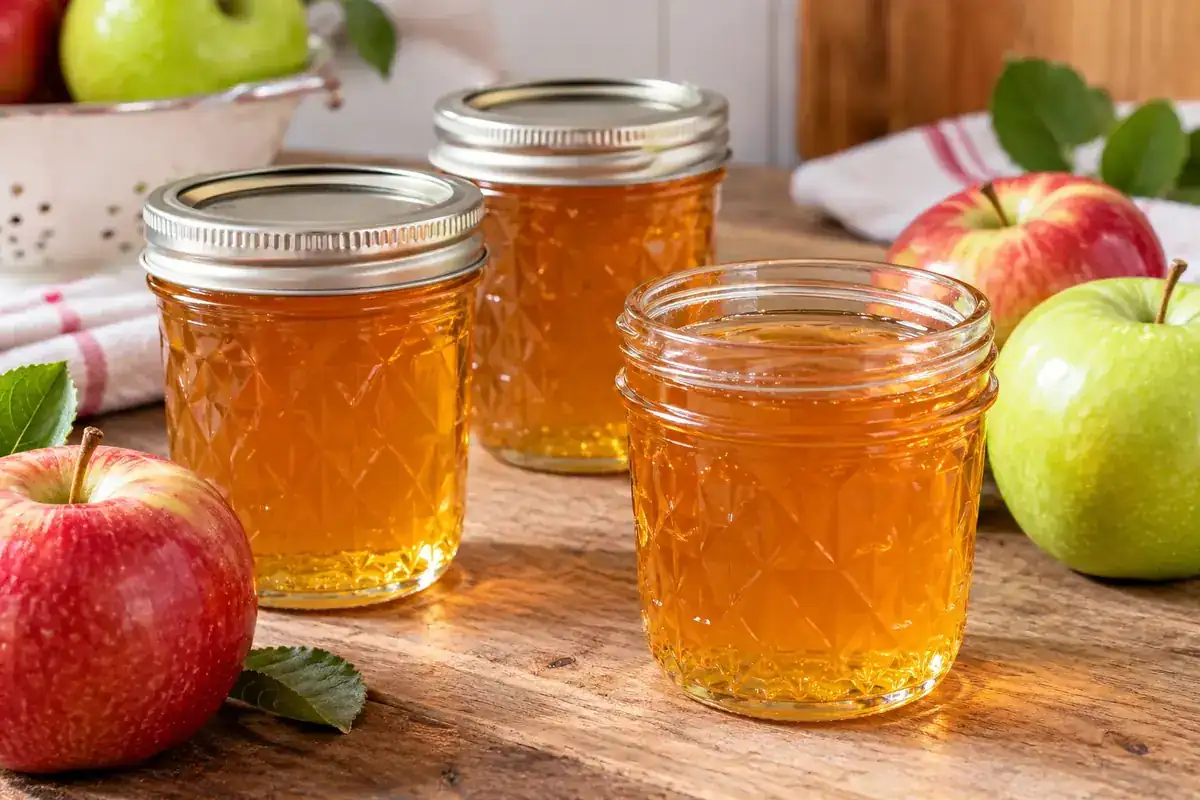
NCHFP Apple Jelly Without Added Pectin
Ingredients
- 4 cups apple juice prepared from about 3 pounds tart apples and 3 cups water
- 2 tablespoons strained lemon juice optional
- 3 cups sugar
Equipment
- 1 Boiling-water bath canner with rack
- 1 Large stainless or enamel preserving pot
- 5 half-pint or 3 pint Canning jars with two-piece lids
- 1 Jelly bag or several layers of damp cheesecloth
- 1 Candy or jelly thermometer optional; for temperature endpoint
Directions
- Wash half-pint or pint canning jars. Because the process is only 5 minutes at 0–1,000 feet, sterilize the jars and keep them hot until filling. Prepare two-piece lids according to the manufacturer directions. Preheat the boiling-water canner.
- Select about one-fourth underripe and three-fourths fully ripe tart apples. Sort and wash them. Remove the stem and blossom ends, but do not peel or core the apples. Cut them into small pieces.
- Place about 3 pounds of prepared apples and 3 cups water in a covered pot. Bring to a boil over high heat, reduce the heat, and simmer for 20 to 25 minutes, or until the apples are soft. Extract the juice through a damp jelly bag. Do not squeeze the bag if you want clear jelly.
- Measure 4 cups apple juice into a large kettle. Add the optional strained lemon juice and 3 cups sugar; stir well. Boil rapidly over high heat until the mixture reaches 8°F above the local boiling point of water, or until it sheets from a spoon. Remove from the heat and quickly skim off the foam.
- Immediately pour the hot jelly into hot, sterile half-pint or pint jars, leaving 1/4-inch headspace. Wipe each rim with a dampened clean paper towel and apply the two-piece lids.
- Process half-pint or pint jars in a boiling-water canner for 5 minutes at 0–1,000 feet, 10 minutes at 1,001–6,000 feet, or 15 minutes above 6,000 feet. Begin timing when the water returns to a full boil.
- After processing, turn off the heat, remove the canner lid, and wait 5 minutes before removing the jars. Cool upright and undisturbed for 12 to 24 hours. Check the seals, remove the screw bands, label, and store. Refrigerate any unsealed jar and use promptly.
Recipe Notes
Private Notes
Questions or results?
Discuss this recipe with the canning community. Community comments do not replace the tested source or safety classification shown on this page.
Join the discussion
Please log in or create a free account to discuss this recipe. You will return here afterward.
Tried this recipe?
Share your results how it turned out.Serving and storage
Cool, verify seals, label, and store correctly.
Frequently asked questions
Is the lemon juice required?
No. The NCHFP formula lists 2 tablespoons of strained lemon juice as optional. It can improve tartness.
Which apples work best?
Use tart apples and include about one-fourth underripe apples with three-fourths ripe apples. Underripe fruit contributes more natural pectin.
Can I reduce the sugar?
Not in this tested no-added-pectin recipe. Sugar is part of the formula that produces the gel. Use a separately tested low-sugar recipe if that is your goal.
Can I use pint or quart jars?
Use half-pint or pint jars; NCHFP provides the same processing schedule for both sizes. Do not use quart jars because no tested processing time is provided for them.
Do the jars need to be sterilized first?
Pre-sterilize jars when using the 5-minute process at 0–1,000 feet. At elevations where the scheduled process is 10 or 15 minutes, pre-sterilization is not required, but the clean jars must still be kept hot until filling.
Can I double the recipe?
No. Larger batches heat and evaporate differently and may not gel reliably. Make separate batches.
Recipe context
Do not combine this record with another preservation formula.
Troubleshooting
Discard food showing spoilage; never taste to determine safety.
Source & provenance
Garden planning for this recipe
Plant, space, variety, zone, and timing estimates live on dedicated ingredient pages: