Safety classification
Tested
Testing authority: Bernardin
Safety reviewed: 09/18/2026
Processing details
Altitude adjustment: Use the exact altitude-adjusted schedule in the tested recipe card.
Source & provenance
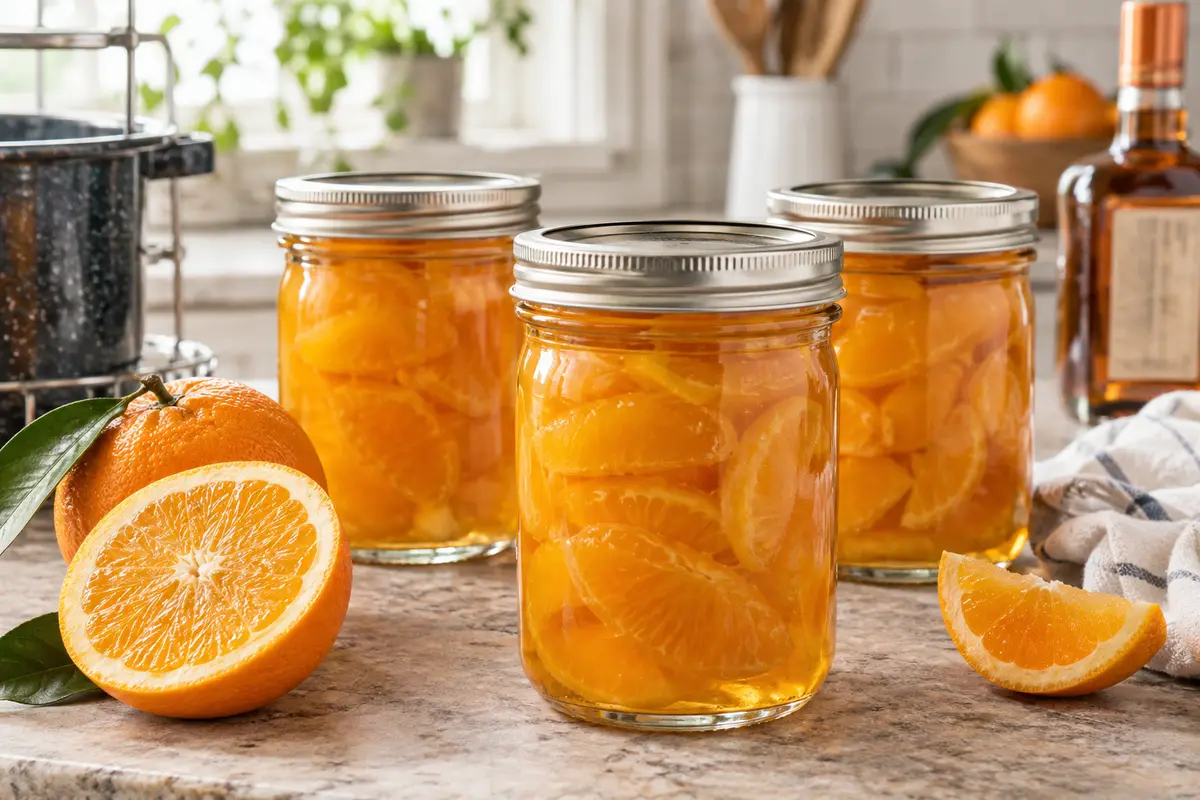
(function(){function p(){var e=document.querySelector(“#post-4880 .entry-content”),s=e&&e.querySelector(“.wprm-recipe-snippet”),n=e&&e.querySelector(“#recipe-quick-nav”);if(e&&s&&n&&s.nextElementSibling!==n)e.insertBefore(s,n)}if(document.readyState===”loading”)document.addEventListener(“DOMContentLoaded”,p);else p();setTimeout(p,250)})();
Safety classification
Tested recipe. Documented by Bernardin.
Processing details
- Method: Boiling-water
canning ; hot pack - Jar size: 250 ml jars
- Headspace: Pack fruit to 3/4 inch (2 cm); cover with liquid to 1/2 inch (1 cm).
- Processing: 15 minutes at altitudes up to 1,000 ft (305 m); follow Bernardin’s guidance above that elevation.
Tested/documented source
Bernardin: Oranges in Cointreau — Bernardin. The source and WPRM card remain authoritative.
Preparation timeline
- Prepare the canner, jars, lids, and measured ingredients.
- Complete every preparation and cooking stage in the card.
- Hot-pack, process for elevation, wait 5 minutes, and cool upright for 24 hours.
Equipment
- Boiling-water canner with rack
- 250 ml jars with lids and bands
- Large nonreactive preserving pot
- Jar lifter, funnel, and bubble/headspace tool
Visual method guide
- Prepare ingredients as documented.
- Cook to the source’s stated stage.
- Hot-pack and maintain Pack fruit to 3/4 inch (2 cm); cover with liquid to 1/2 inch (1 cm)..
- Process under at least 1 inch of boiling water.
Safety essentials
Keep the tested orange, clove, cinnamon, sugar, water, Cointreau, and white-wine proportions and both documented fill levels.
Do not enlarge jar size or shorten processing time. Refrigerate any unsealed jar.
About this recipe
Oranges in Cointreau — Bernardin is a tested Bernardin fruit preserve or condiment.
Before you begin
Read the complete recipe card and source, measure every ingredient, and confirm your elevation.
Altitude-adjusted processing
15 minutes at altitudes up to 1,000 ft (305 m); use Bernardin’s documented adjustment above that elevation.
Oranges in Cointreau — Bernardin
Ingredients
- 9 small or medium Navel oranges, about 3 1/4 lb (1.5 kg)
- 10 whole cloves
- 5 cinnamon sticks, broken in half
- 3- 1/2 cups (875 ml) granulated sugar
- 2/3 cup (150 ml) water
- 3/4 cup (175 ml) Cointreau (orange liqueur)
- 1/2 cup (125 ml) white wine
Equipment
- 1 Boiling-water bath canner with rack
- 1 Large stainless or enamel preserving pot
- 1 Canning jars with two-piece lids
- 1 Headspace and bubble tool
Directions
- Place 8 clean 250 ml mason jars on a rack in a boiling water canner. Cover jars with water and heat to a simmer (180°F/82°C). Set screw bands aside. Keep jars hot until ready to use. Preheating Bernardin® lids is not advised.
- The sealing compound used for our home canning lids performs better at room temperature than it does pre-heated in simmering water (180°F). Simply wash lids in hot, soapy water, dry, and set aside until needed.
- Preheating can lead to less vacuum being achieved during water bath canning, and to buckle failures during pressure canning. Wash and cut 1/2 inch (1 cm) off both ends of oranges. Thinly slice oranges with a food processor or sharp knife, creating pinwheels approximately 1/8 inch (3 mm) thick.
- Carefully remove any seeds. Set orange slices aside. Tie cinnamon sticks and cloves in a square of cheesecloth, creating a spice bag. Combine spice bag, sugar and water in a large, stainless steel saucepan. Mix well.
- Slowly bring to a boil; reduce heat to low and boil gently 10 minutes, stirring occasionally. Remove spice bag. Add orange slices, Cointreau and wine to sugar mixture. Stirring gently, heat until mixture begins to boil. Remove from heat.
- Carefully layer orange slices loosely into a hot jar to within 1 inch (2.5 cm) of top rim. Add hot liquid to cover oranges to within 1/2 inch (1 cm) of top of jar (headspace).
- Using nonmetallic utensil, remove air bubbles and adjust headspace, if required, by adding more orange slices and hot liquid. Wipe jar rim removing any food residue. Centre sealing disc on clean jar rim. Screw band down until resistance is met, then increase to fingertip tight.
- Return filled jar to rack in canner. Repeat for remaining orange slices and hot liquid. When canner is filled, ensure that all jars are covered by at least one inch (2.5 cm) of water. Cover canner and bring water to full rolling boil before starting to count processing time.
- At altitudes up to 1000 ft (305 m), process -boil filled jars - 15 minutes.* When processing time is complete, remove canner lid, wait 5 minutes, then remove jars without tilting and place them upright on a protected work surface. Cool upright, undisturbed 24 hours; DO NOT RETIGHTEN screw bands.
- After cooling check jar seals. Sealed discs curve downward and do not move when pressed. Remove screw bands; wipe and dry bands and jars. Store screw bands separately or replace loosely on jars, as desired. Label and store jars in a cool, dark place.
- For best quality, use home canned foods within one year.
- Processing: At altitudes up to 1000 ft (305 m), process -boil filled jars - 15 minutes - 15 minutes.
- Altitude-adjusted processing table: At altitudes up to 1000 ft (305 m), process -boil filled jars - 15 minutes
Recipe Notes
Private Notes
Questions or results?
Discuss this recipe with the canning community. Community comments do not replace the tested source or safety classification shown on this page.
Join the discussion
Please log in or create a free account to discuss this recipe. You will return here afterward.
Tried this recipe?
Share your results how it turned out.Serving suggestions
Serve or use according to the preserve’s fruit, condiment, or dessert profile.
Frequently asked questions
Can I use a larger jar?
No. Use only the documented jar size.
Can I change the formula?
Do not alter the tested formulation for shelf-stable storage.
Recipe context
This tested preserve is not interchangeable with an unprocessed refrigerator preparation.
Troubleshooting
Seal failure: Refrigerate the jar. Discard spoiled food without tasting.
Source and provenance
Primary source: Bernardin. Editorial organization changes only.