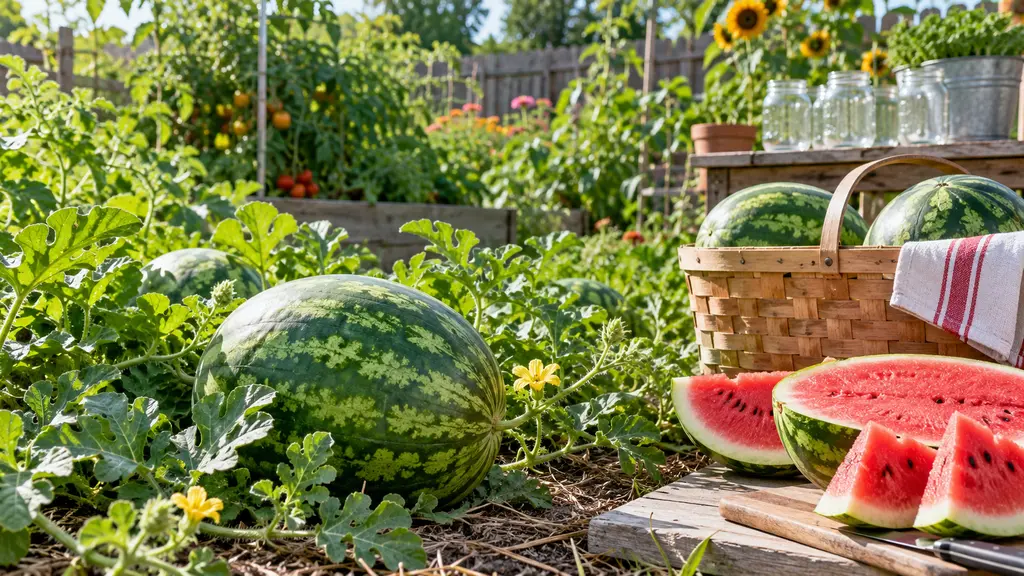
Plan watermelons for tested rind pickles and preserves using cited transplant density, row yield, vine spacing, and warm-season timing.
Your growing location
Hardiness zone describes winter minimum temperature. It does not replace frost dates, day length, soil temperature, or current weather.
Nothing is shared until you choose a lookup button. ZIP lookup uses PHZMAPI. “Use my location” sends coordinates to BigDataCloud only to obtain a ZIP, then sends that ZIP to PHZMAPI; coordinates are not stored by this site.
Verify the result on the official USDA 2023 map; manual override always remains available.
Plants and space calculator
Space by planting style
Preservation-suitable variety direction
Zone is only one factor. Day length, disease pressure, storage quality, maturity, and use may be more important.
Thick-rind locally adapted watermelons
Choose disease resistance and maturity for the frost-free season; preserve only with a tested rind or fruit recipe.
Planting and indoor-start timing
Direct sow or transplant after frost danger when soil is warm. Allow the cultivar’s full days to maturity before first fall frost.
Current weather is not loaded automatically; check the local forecast and soil before planting.
Canning recipes using watermelon
Sources, formulas, and limits
Plants = household annual target ÷ selected yield per plant, rounded up. Area or row units = target ÷ compatible cited yield, rounded up. “Typical” uses the cited midpoint.
Virginia Cooperative Extension expert-reviewed home garden planting guide