Safety classification
Tested
Testing authority: National Center for Home Food Preservation (University of Georgia / USDA-derived guidance)
Safety reviewed: 09/09/2026
Processing details
Altitude adjustment: Dial gauge: 11 psi at 0–2,000 ft; 12 psi at 2,001–4,000 ft; 13 psi at 4,001–6,000 ft; 14 psi at 6,001–8,000 ft. Weighted gauge: 10 psi at 0–1,000 ft; 15 psi above 1,000 ft.
Source & provenance
Safety classification: Tested recipe from NCHFP.
Chicken or rabbit canning safety
| Method | Pressure |
|---|---|
| Pack | Hot or raw pack; bone-in or boneless |
| Jar sizes | Pint or quart |
| Headspace | 1¼ inches |
| Quantity | Prepare sound, properly chilled meat; yield varies by animal and cut |
Safety boundary: Processing time changes with bones; never apply the shorter bone-in time to boneless meat.
Processing details
- Method
- Pressure
- Pack style
- Either
- Jar sizes
- Pint or Quart Jars
- Headspace
- 1 1/4 inches
- Processing time
- Without bones: pints 75 min, quarts 90 min; with bones: pints 65 min, quarts 75 min
Tested recipe source: National Center for Home Food Preservation (NCHFP)
Chicken or rabbit timeline
- Prepare: Use sound chilled meat, remove excess fat, and choose the complete hot or raw pack.
- Pack: Pack bone-in or boneless meat exactly as directed and leave 1¼-inch headspace.
- Process: Use the bone-in or boneless time that matches every jar.
Equipment for chicken or rabbit
Affiliate disclosure: Equipment links may earn a commission at no added cost; safety guidance is independent.
- Pressure canner with rack and tested dial or weighted gauge
- Pint or quart Mason jars with two-piece lids
- Large pot,
canning funnel, jar lifter, headspace tool, and bubble remover
Visual method guide
- Chill meat properly and remove excess fat.
- Choose hot pack or raw pack and bone-in or boneless pieces.
- Keep jars consistent with the selected bone status.
- Leave 1¼-inch headspace and pressure-can.
The official source and WPRM recipe card remain authoritative.
Safety essentials
Tested NCHFP pressure-canning procedure with hot- and raw-pack options. Processing time differs for bone-in and boneless meat.
What is chicken or rabbit?
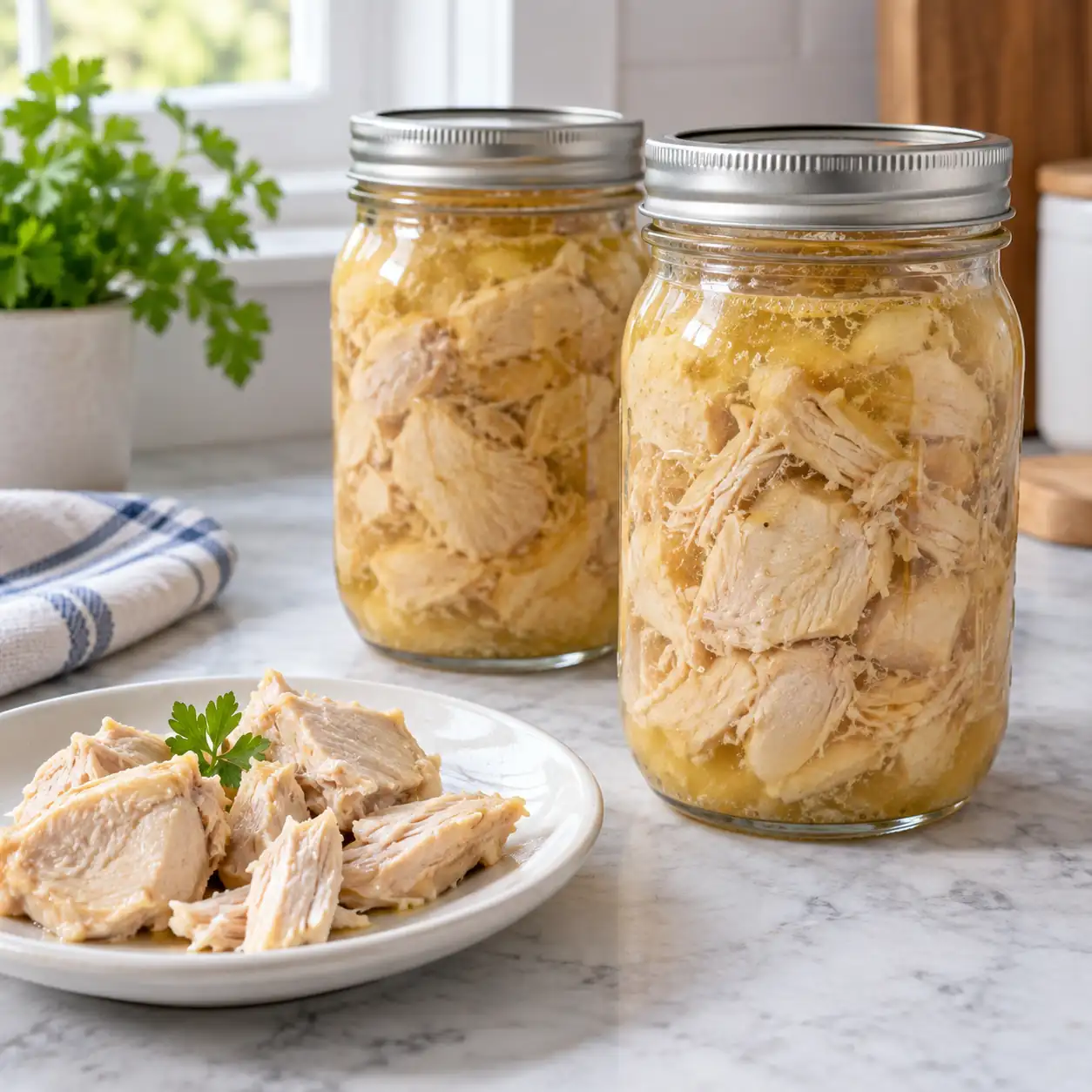
This tested process pressure cans chicken or rabbit by hot or raw pack, with different times for bone-in and boneless jars.
Before you begin
- Hot pack is preferred for best liquid coverage and yield.
- Do not mix bone-in and boneless schedules.
- Salt is optional.
Altitude-adjusted pressure schedule
| Jar/style | Time | 0–2,000 ft | 2,001–4,000 ft | 4,001–6,000 ft | 6,001–8,000 ft |
|---|---|---|---|---|---|
| Pints, boneless | 75 min | 11 psi | 12 psi | 13 psi | 14 psi |
| Quarts, boneless | 90 min | 11 psi | 12 psi | 13 psi | 14 psi |
| Pints, with bones | 65 min | 11 psi | 12 psi | 13 psi | 14 psi |
| Quarts, with bones | 75 min | 11 psi | 12 psi | 13 psi | 14 psi |
| Jar/style | Time | 0–1,000 ft | Above 1,000 ft |
|---|---|---|---|
| Pints, boneless | 75 min | 10 psi | 15 psi |
| Quarts, boneless | 90 min | 10 psi | 15 psi |
| Pints, with bones | 65 min | 10 psi | 15 psi |
| Quarts, with bones | 75 min | 10 psi | 15 psi |
Chicken or Rabbit — NCHFP
Ingredients
- freshly dressed chicken or rabbit remove excess fat and cut to fit jars
- 1 tsp salt optional per quart
- hot broth hot pack only
Equipment
- 1 Pressure canner Dial- or weighted-gauge pressure canner appropriate for altitude.
- As needed Canning jars Pints or quarts; quantity depends on meat and pack style.
- As needed Two-piece canning lids Use new flat lids and prepare according to manufacturer directions.
Directions
- Chill dressed chicken 6–12 hours. For rabbit, soak 1 hour in water containing 1 tbsp salt per quart, then rinse. Remove excess fat.
- Hot pack: cook meat about two-thirds done, pack with hot broth and optional salt, leaving 1 1/4-inch headspace. Raw pack: pack raw pieces loosely with optional salt and no liquid, leaving 1 1/4-inch headspace.
- Without bones: process pints 75 minutes or quarts 90 minutes.
- With bones: process pints 65 minutes or quarts 75 minutes.
- Dial 11/12/13/14 psi by altitude; weighted 10 psi through 1,000 ft and 15 psi above.
Recipe Notes
Private Notes
Questions or results?
Discuss this recipe with the canning community. Community comments do not replace the tested source or safety classification shown on this page.
Join the discussion
Please log in or create a free account to discuss this recipe. You will return here afterward.
Tried this recipe?
Share your results how it turned out.How to serve chicken or rabbit
Heat thoroughly and use in soups, casseroles, sandwiches, tacos, pot pies, and pasta dishes.
Chicken or rabbit questions
Why does bone-in meat use a shorter time?
The tested tables specify different schedules; match each jar to the correct bone status without extrapolating.
Can I use a boiling-water canner?
No. This low-acid food requires pressure
What if pressure drops?
Restore the required pressure and restart the full processing time.
Bone-in versus boneless poultry
Bone-in jars process for 65 minutes in pints and 75 in quarts; boneless jars require 75 and 90 minutes.
Chicken or rabbit troubleshooting
Why is liquid coverage low?
Use hot pack for better coverage, remove excess fat, and maintain the full headspace.
What if a jar does not seal?
Refrigerate promptly or follow an authoritative reprocessing procedure within the permitted time.
Source & provenance
NCHFP, “Chicken or Rabbit”. Official USDA/NCHFP tested home-canning guidance.
Editorial review: Supporting blocks checked against the official source on September 20, 2026. The WPRM recipe card was preserved.
Typical canning season
Season: All Year
Months: January, February, March, April, May, June, July, August, September, October, November, December
How much of the main ingredient should I grow?
Not applicable as a garden crop; plan purchases or harvest separately
This recipe does not have a reliable garden conversion. Plan a purchase or harvest separately, and do not use garden estimates to alter the tested recipe.
Garden yields vary by cultivar, climate, soil, pests, and care. Always measure the exact prepared ingredient amount required by the tested canning recipe.