Safety classification
Tested
Testing authority: National Center for Home Food Preservation (University of Georgia / USDA-derived guidance)
Safety reviewed: 09/09/2026
Processing details
Altitude adjustment: Increase boiling-water processing by elevation: pints 5/10/15 min and quarts 10/15/20 min at 0–1,000 / 1,001–6,000 / above 6,000 ft.
Source & provenance
Safety classification: Tested recipe from NCHFP.
Pickled mixed vegetables safety
| Method | Boiling-water |
|---|---|
| Pack | Hot pack |
| Jar sizes | Pints or quarts |
| Headspace | ½ inch |
| Yield | About 10 pints |
Processing details
Method: Boiling-water
Tested source
Tested recipe source: National Center for Home Food Preservation (NCHFP)
Pickled mixed vegetables timeline
- Prepare and chill: Cut the specified cucumbers, onions, celery, carrots, peppers, and cauliflower and follow the tested salting/chilling step.
- Heat: Prepare the 5% vinegar pickling liquid and hot-pack the tested mixture.
- Fill and process: Leave ½-inch headspace and use the altitude-adjusted boiling-water schedule.
Equipment for pickled mixed vegetables
Affiliate disclosure: Equipment links may earn a commission at no added cost; safety guidance is independent.
- Boiling-water canner with rack
- Pint or quart Mason jars with two-piece lids
- Nonreactive pot, colander, ladle, funnel, jar lifter, and headspace tool
Visual method guide
- Measure and cut each specified vegetable as directed.
- Complete the tested salting and chilling step; drain as directed.
- Use white vinegar labeled 5% acidity and prepare the full pickling liquid.
- Hot-pack, leave ½-inch headspace, and process by altitude.
The official source and WPRM recipe card remain authoritative.
Safety essentials
Safety boundary: Use vinegar labeled 5% acidity and keep all tested vegetable, vinegar, and seasoning proportions. Do not skip the specified chilling step.
What are pickled mixed vegetables?
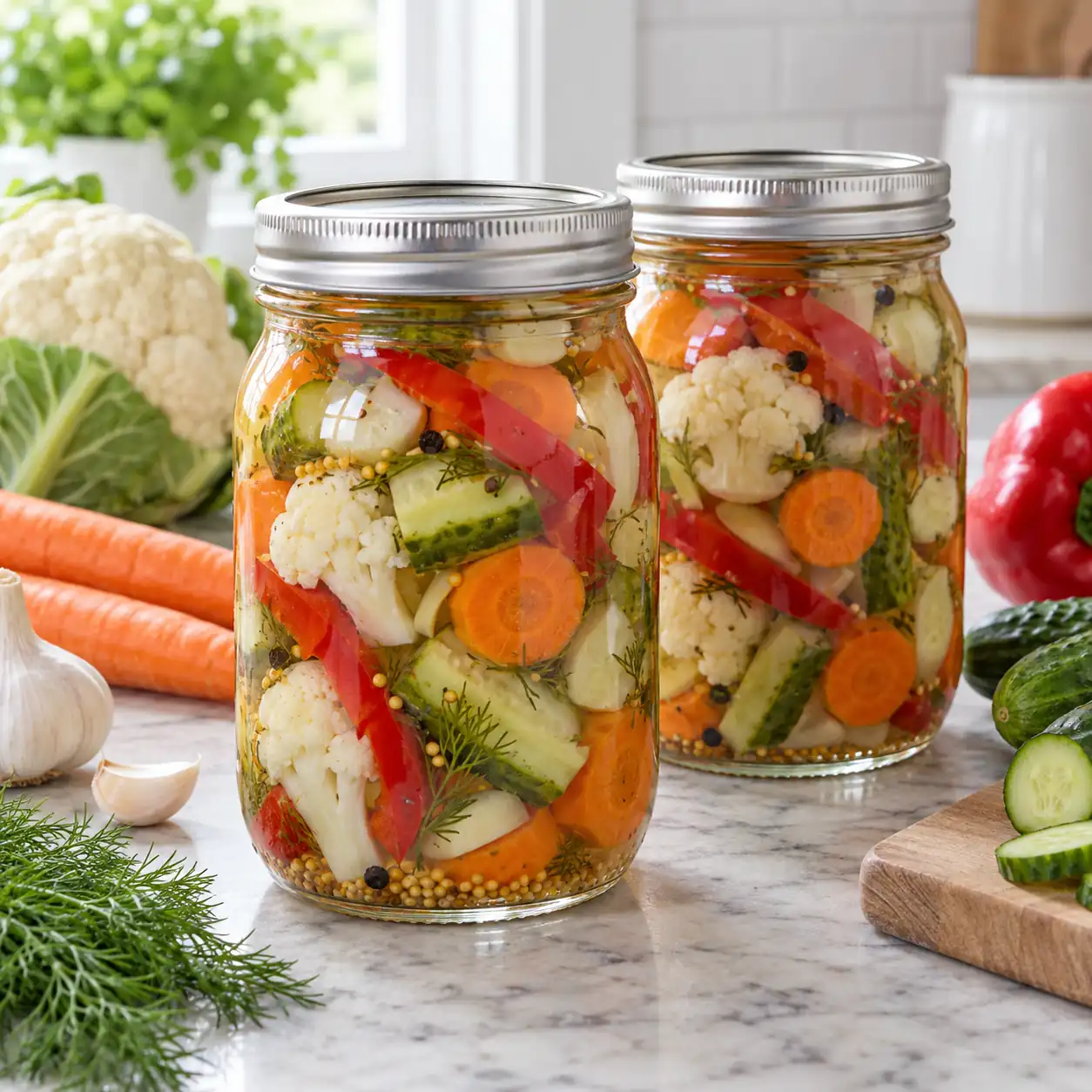
This tested pickle combines cucumbers, onions, celery, carrots, sweet red peppers, and cauliflower in an acidified 5% vinegar solution.
Before you begin
- Use only the listed vegetables in the tested quantities.
- Use white vinegar labeled 5% acidity.
- Follow the complete salting, chilling, draining, hot-pack, and processing directions.
- Do not use jars larger than quarts.
Altitude-adjusted processing time
| Jar | 0–1,000 ft | 1,001–6,000 ft | Above 6,000 ft |
|---|---|---|---|
| Pints | 5 min | 10 min | 15 min |
| Quarts | 10 min | 15 min | 20 min |
Pickled Mixed Vegetables — NCHFP
Ingredients
- 4 lb pickling cucumbers 4- to 5-inch cucumbers, washed and cut into 1-inch slices; remove 1/16 inch from blossom end
- 2 lb small onions peeled and quartered
- 4 cups celery cut into 1-inch pieces
- 2 cups carrots peeled and cut into 1/2-inch pieces
- 2 cups sweet red peppers cut into 1/2-inch pieces
- 2 cups cauliflower flowerets
- 5 cups white vinegar 5% acidity
- 1/4 cup prepared mustard
- 1/2 cup canning or pickling salt
- 3 1/2 cups sugar
- 3 tbsp celery seed
- 2 tbsp mustard seed
- 1/2 tsp whole cloves
- 1/2 tsp ground turmeric
Equipment
- 1 Boiling-water canner For tested hot-pack processing.
- 5–10 Canning jars About 10 pints or equivalent permitted quart capacity.
- 5–10 Two-piece canning lids Prepare according to manufacturer directions.
Directions
- Combine the prepared vegetables, cover with 2 inches of cubed or crushed ice, and refrigerate 3 to 4 hours.
- In an 8-quart kettle, combine the 5% acidity vinegar and prepared mustard. Mix well. Add salt, sugar, celery seed, mustard seed, cloves, and turmeric; bring to a boil.
- Drain the chilled vegetables and add them to the hot pickling solution. Cover and slowly bring to a boil.
- Drain the vegetables, reserving the pickling solution. Fill vegetables into hot sterile pint jars, or hot clean quart jars, leaving 1/2-inch headspace. Add hot pickling solution, maintaining 1/2-inch headspace. Remove air bubbles, adjust headspace, wipe rims, and apply lids.
- Process hot-pack pints in a boiling-water canner for 5 minutes at 0–1,000 ft, 10 minutes at 1,001–6,000 ft, or 15 minutes above 6,000 ft.
- For quarts, process 10 minutes at 0–1,000 ft, 15 minutes at 1,001–6,000 ft, or 20 minutes above 6,000 ft.
Recipe Notes
Private Notes
Questions or results?
Discuss this recipe with the canning community. Community comments do not replace the tested source or safety classification shown on this page.
Join the discussion
Please log in or create a free account to discuss this recipe. You will return here afterward.
Tried this recipe?
Share your results how it turned out.How to serve pickled mixed vegetables
Serve chilled with sandwiches, salads, cheese boards, grain bowls, or grilled foods. Refrigerate after opening.
Pickled mixed vegetable questions
Can I change the vegetables?
No. Keep the tested vegetables and proportions.
Can I use weaker vinegar?
No. Use vinegar labeled 5% acidity.
Can I skip chilling?
No. Follow the complete tested preparation, including chilling and draining.
Mixed vegetable pickles versus refrigerator pickles
This recipe uses a fixed acid balance and boiling-water process for shelf stability. Refrigerator pickles are stored cold and are not interchangeable with this
Pickled mixed vegetable troubleshooting
Why are the vegetables soft?
Use fresh produce, follow the chilling step and heating times, and avoid overprocessing.
Why is the liquid cloudy?
Use the specified salt and 5% vinegar, clean produce well, and avoid altering the formula.
What if a jar does not seal?
Refrigerate promptly or follow an authoritative reprocessing procedure within the permitted time.
Source & provenance
NCHFP, “Pickled Mixed Vegetables”. Adapted from the USDA Complete Guide to Home
Editorial review: Supporting blocks checked against the official source on September 20, 2026. The WPRM recipe card was preserved.
Garden planning for this recipe
Plant, space, variety, zone, and timing estimates live on dedicated ingredient pages:
Typical canning season
Season: Summer, Fall
Months: July, August, September, October
How much of the main ingredient should I grow?
12–25 lb of Pickling cucumbers per person per year
This is an annual planning range that includes preserving and typical fresh use. Plant, row-foot, and square-foot estimates are shown only when compatible cited yield or spacing data is available.
Garden yields vary by cultivar, climate, soil, pests, and care. Always measure the exact prepared ingredient amount required by the tested canning recipe.