Safety classification
Tested
Testing authority: National Center for Home Food Preservation (University of Georgia / USDA-derived guidance)
Safety reviewed: 09/09/2026
Processing details
Altitude adjustment: Boiling-water times increase by altitude. Pressure options vary by gauge, altitude, and selected processing schedule; follow one complete NCHFP schedule.
Source & provenance
Safety classification: Tested recipe from NCHFP.
Tomato and vegetable juice safety
| Method | Boiling-water |
|---|---|
| Jar sizes | Pints or quarts |
| Headspace | ½ inch |
| Vegetable limit | No more than 3 cups per 22 lb tomatoes |
| Acidification | Required for every jar under every process option |
Processing details
Methods: Boiling-water
Tested source
Tested recipe source: National Center for Home Food Preservation (NCHFP)
Tomato and vegetable juice timeline
- Prepare: Crush tomatoes and finely chop no more than 3 cups total celery, onions, carrots, and peppers per 22 pounds tomatoes.
- Cook and strain: Simmer vegetables with tomatoes 20 minutes, then press through a sieve or food mill.
- Acidify and process: Acidify every jar, reheat to boiling, fill with ½-inch headspace, and use one complete tested process.
Equipment for tomato–vegetable juice
Affiliate disclosure: Equipment links may earn a commission at no added cost; safety guidance is independent.
- Boiling-water canner or pressure canner with rack
- Pint or quart Mason jars and two-piece lids
- Large pot, sieve or food mill, ladle, funnel, jar lifter, and headspace tool
Visual method guide
- Crush and simmer tomatoes as for tomato juice.
- Add no more than 3 cups permitted finely chopped vegetables per 22 pounds tomatoes; simmer 20 minutes.
- Press through a sieve or food mill and reheat the juice to boiling.
- Acidify each jar, fill with ½-inch headspace, and process by one complete schedule.
The official source and WPRM recipe card remain authoritative.
Safety essentials
Safety boundary: Do not exceed the vegetable limit, omit acidification, or combine time and pressure values from different options.
What is tomato and vegetable juice blend?
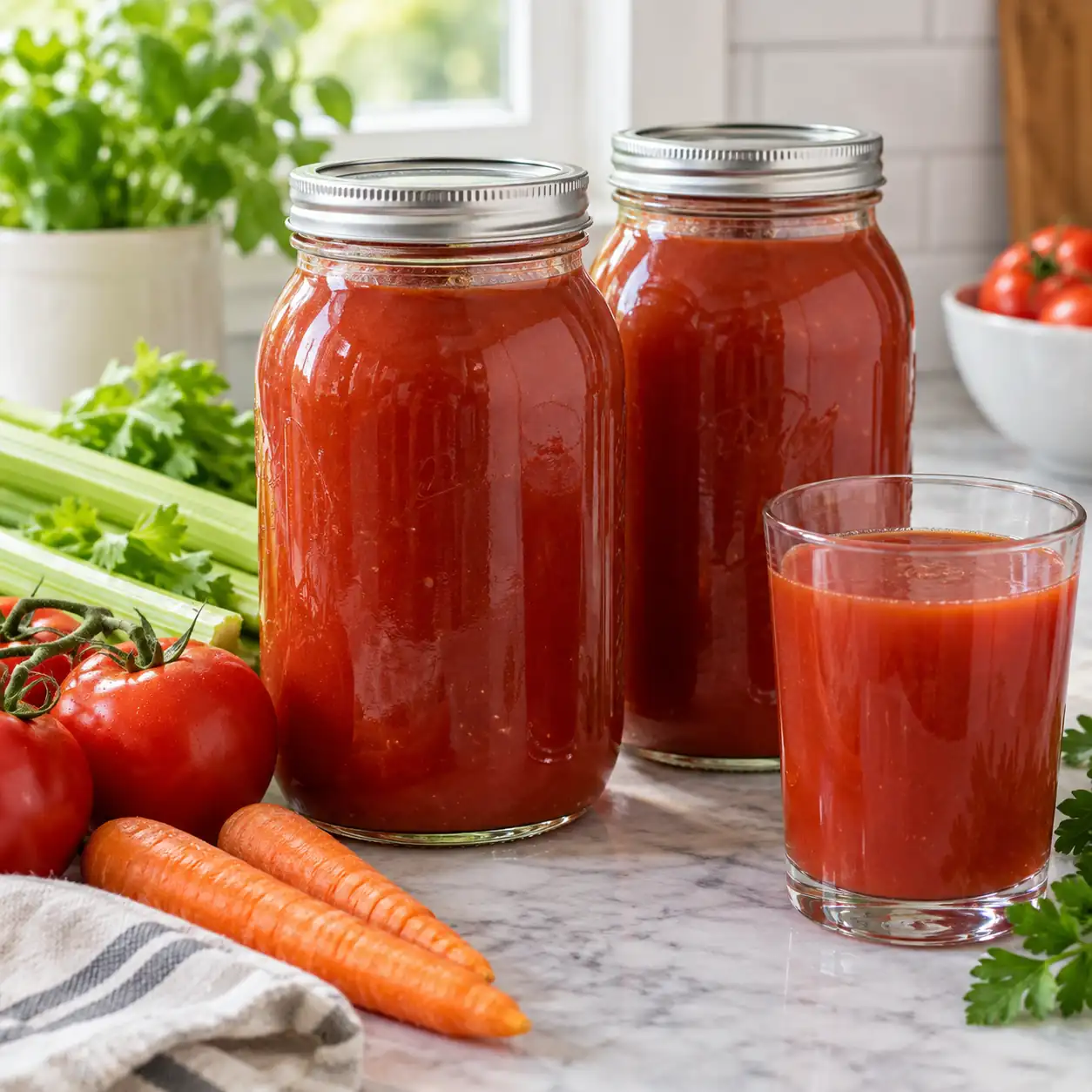
This tested tomato juice adds a limited quantity of finely chopped celery, onions, carrots, and/or peppers before cooking and straining.
Before you begin
- Use about 22 pounds tomatoes for a 7-quart canner load.
- Measure no more than 3 cups total permitted vegetables.
- Use current NCHFP bottled-lemon-juice or citric-acid amounts for every jar.
- Salt is optional.
Altitude-adjusted processing
| Jar | 0–1,000 ft | 1,001–3,000 ft | 3,001–6,000 ft | Above 6,000 ft |
|---|---|---|---|---|
| Pints | 35 min | 40 min | 45 min | 50 min |
| Quarts | 40 min | 45 min | 50 min | 55 min |
NCHFP also provides several tested pressure/time combinations. Select one complete option for your gauge and altitude from the official source; acidification remains required.
Tomato and Vegetable Juice Blend — NCHFP
Ingredients
- 22 lb tomatoes average amount for a canner load of 7 quarts
- 3 cups finely chopped celery, onions, carrots, and/or peppers maximum total amount per 22 lb tomatoes; use any combination
- bottled lemon juice or citric acid required; use current NCHFP tomato acidification amounts for the jar size
- 1 tsp salt optional, per quart jar
Equipment
- 1 Boiling-water canner For the boiling-water processing option.
- 1 Pressure canner For a complete tested pressure-processing option.
- 7–9 Canning jars Pints or quarts.
- 7–9 Two-piece canning lids Prepare according to manufacturer directions.
Directions
- Crush and simmer tomatoes as for making tomato juice.
- Add no more than 3 cups total finely chopped celery, onions, carrots, and peppers for each 22 pounds of tomatoes. Simmer the mixture 20 minutes.
- Press the hot cooked tomatoes and vegetables through a sieve or food mill to remove skins and seeds.
- Add bottled lemon juice or citric acid to each jar according to current NCHFP tomato acidification directions. Add 1 teaspoon salt per quart if desired.
- Reheat the tomato-vegetable juice blend to boiling. Fill jars immediately, leaving 1/2-inch headspace. Adjust lids.
- Boiling-water option — pints: 35 minutes at 0–1,000 ft, 40 at 1,001–3,000 ft, 45 at 3,001–6,000 ft, 50 above 6,000 ft. Quarts: 40, 45, 50, and 55 minutes at the same altitude bands.
- Dial-gauge pressure options for pints or quarts: 20 minutes at 6 psi (0–2,000 ft), 7 psi (2,001–4,000), 8 psi (4,001–6,000), 9 psi (6,001–8,000); or 15 minutes at 11, 12, 13, and 14 psi at those same altitude bands.
- Weighted-gauge pressure options for pints or quarts: 20 minutes at 5 psi through 1,000 ft and 10 psi above 1,000 ft; or 15 minutes at 10 psi through 1,000 ft and 15 psi above 1,000 ft. The 10-minute/15-psi option is listed only through 1,000 ft and is not recommended above 1,000 ft.
Recipe Notes
Private Notes
Questions or results?
Discuss this recipe with the canning community. Community comments do not replace the tested source or safety classification shown on this page.
Join the discussion
Please log in or create a free account to discuss this recipe. You will return here afterward.
Tried this recipe?
Share your results how it turned out.How to serve tomato and vegetable juice
Serve chilled, warm as a savory drink, or use as a base for soups, sauces, rice, and braises. Refrigerate after opening.
Tomato and vegetable juice questions
Is acidification required when pressure canning ?
Yes. NCHFP requires acidification under every listed option.
Can I add more vegetables?
No. Do not exceed 3 cups total permitted vegetables per 22 pounds tomatoes.
Can I mix the listed pressure options?
No. Use one complete time, pressure, gauge, and altitude option.
Tomato juice versus tomato–vegetable juice
The blend permits a strictly limited quantity of celery, onion, carrot, and pepper. Plain tomato juice follows its own tested preparation but shares the acidification requirement.
Tomato and vegetable juice troubleshooting
Why did the juice separate?
Some separation can occur; follow the rapid heating, simmering, and straining directions and shake only after opening.
What if I forgot the acid?
Do not store the jars at room temperature. Follow authoritative reprocessing guidance within the permitted time or refrigerate promptly.
What if pressure or boiling was interrupted?
Follow the restart rule for the selected
Source & provenance
NCHFP, “Tomato and Vegetable Juice Blend”. Adapted from the USDA Complete Guide to Home
Editorial review: Supporting blocks checked against the official source on September 20, 2026. The WPRM recipe card was preserved.
Garden planning for this recipe
Plant, space, variety, zone, and timing estimates live on dedicated ingredient pages:
Typical canning season
Season: Summer, Fall
Months: July, August, September, October
How much of the main ingredient should I grow?
40–80 lb of Tomatoes per person per year
The source-cited calculator below can convert your pantry goal into row foot estimates where compatible yield data exists.
Garden yields vary by cultivar, climate, soil, pests, and care. Always measure the exact prepared ingredient amount required by the tested canning recipe.