Safety classification
Tested
Testing authority: National Center for Home Food Preservation (University of Georgia / USDA-derived guidance)
Safety reviewed: 09/09/2026
Processing details
Altitude adjustment: Dial gauge: 11 psi at 0–2,000 ft; 12 psi at 2,001–4,000 ft; 13 psi at 4,001–6,000 ft; 14 psi at 6,001–8,000 ft. Weighted gauge: 10 psi at 0–1,000 ft; 15 psi above 1,000 ft.
Source & provenance
Safety classification: Tested recipe from NCHFP.
Spinach and greens canning safety
| Method | Pressure |
|---|---|
| Pack | Hot pack; loose fill |
| Jar sizes | Pints or quarts |
| Headspace | 1 inch |
| Quantity | About 18 lb per 9 pints or 28 lb per 7 quarts |
Processing details
Method: Pressure
Tested source
Tested recipe source: National Center for Home Food Preservation (NCHFP)
Spinach and greens canning timeline
- Sort and wash: Use fresh tender leaves; repeatedly rinse small batches until free of grit.
- Wilt: Remove tough stems and steam 1 pound at a time for 3–5 minutes.
- Fill and process: Pack loosely, add boiling water to 1-inch headspace, and pressure-can.
Equipment for canning greens
Affiliate disclosure: Equipment links may earn a commission at no added cost; safety guidance is independent.
- Pressure canner with rack and a tested dial or weighted gauge
- Mason jars, two-piece lids, jar lifter,
canning funnel, headspace tool, and bubble remover - Large stainless-steel pot and clean towels
- Cheesecloth bag or blancher basket for steaming one-pound batches
Visual method guide
- Discard wilted, discolored, diseased, or insect-damaged leaves.
- Wash small batches repeatedly until the water is clear and grit-free.
- Remove tough stems and midribs.
- Steam 1 pound at a time for 3–5 minutes until well wilted.
- Fill jars loosely, add fresh boiling water to 1-inch headspace, and pressure-can.
The official source and WPRM recipe card remain authoritative.
Safety essentials
Safety boundary: Use fresh tender greens, steam-wilt as directed, pack loosely, add boiling water, and use the complete pressure schedule.
What are pressure-canned spinach and greens?
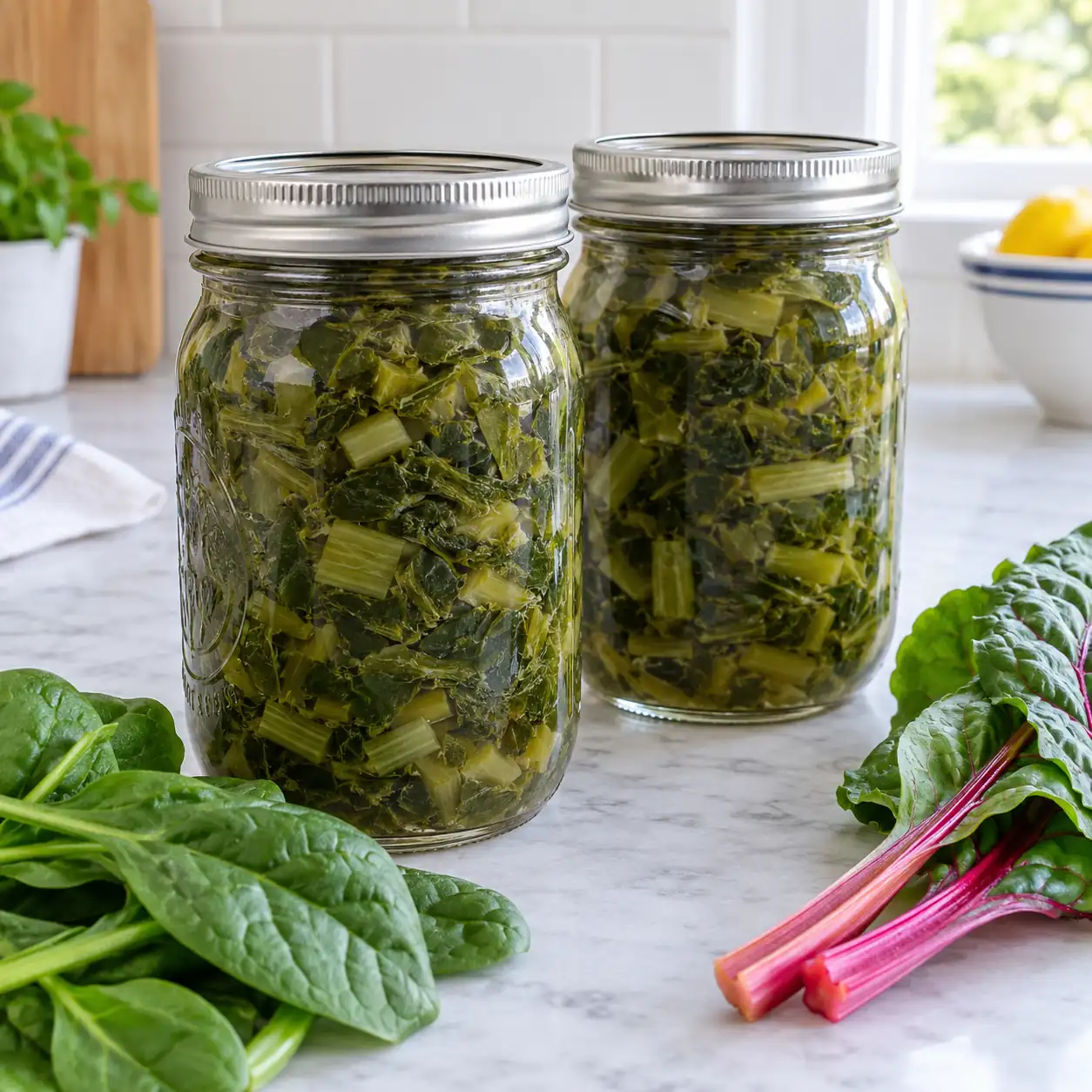
This tested NCHFP method preserves freshly harvested spinach and other tender greens as a loose hot pack in a pressure canner.
Before you begin
- Plan on about 4 pounds of fresh greens per finished quart on average.
- Remove all tough stems and midribs.
- Work in one-pound steaming batches so the greens wilt evenly.
- Salt is optional: ½ teaspoon per quart jar.
Altitude-adjusted pressure schedule
| Jar | Time | 0–2,000 ft | 2,001–4,000 ft | 4,001–6,000 ft | 6,001–8,000 ft |
|---|---|---|---|---|---|
| Pints | 70 min | 11 psi | 12 psi | 13 psi | 14 psi |
| Quarts | 90 min | 11 psi | 12 psi | 13 psi | 14 psi |
| Jar | Time | 0–1,000 ft | Above 1,000 ft |
|---|---|---|---|
| Pints | 70 min | 10 psi | 15 psi |
| Quarts | 90 min | 10 psi | 15 psi |
Spinach and Other Greens — NCHFP
Ingredients
- 28 lb fresh spinach or other tender greens average amount for 7 quarts; use about 18 lb for 9 pints
- 1/2 tsp salt optional, per quart jar
- fresh boiling water enough to cover loosely packed greens while maintaining 1-inch headspace
Equipment
- 1 Pressure canner Dial- or weighted-gauge pressure canner appropriate for altitude.
- Canning jars Pints or quarts.
- Two-piece canning lids Prepare according to manufacturer directions.
Directions
- Wash small amounts of greens at a time. Drain and rinse repeatedly until water is clear and free of grit. Remove tough stems and midribs.
- Place 1 pound of greens at a time in a cheesecloth bag or blancher basket and steam 3 to 5 minutes, or until well wilted.
- Add 1/2 teaspoon salt to each quart jar if desired. Fill jars loosely with greens and add fresh boiling water, leaving 1-inch headspace. Adjust lids.
- Process pints 70 minutes or quarts 90 minutes in a pressure canner.
- Dial gauge: 11 psi at 0–2,000 ft, 12 psi at 2,001–4,000 ft, 13 psi at 4,001–6,000 ft, and 14 psi at 6,001–8,000 ft. Weighted gauge: 10 psi at 0–1,000 ft and 15 psi above 1,000 ft.
Recipe Notes
Private Notes
Questions or results?
Discuss this recipe with the canning community. Community comments do not replace the tested source or safety classification shown on this page.
Join the discussion
Please log in or create a free account to discuss this recipe. You will return here afterward.
Tried this recipe?
Share your results how it turned out.How to serve canned greens
Drain and heat with your preferred seasonings, or add to soups, beans, casseroles, and savory pies. Refrigerate leftovers.
Spinach and greens canning questions
Can I pack the greens tightly?
No. The source directs filling jars loosely.
Why steam only one pound at a time?
Small batches wilt more evenly and match the tested preparation method.
Is salt required?
No. It is optional for flavor.
Canning greens versus freezing greens
This recipe produces shelf-stable pressure-canned greens with a soft cooked texture. Freezing uses a different preservation method and generally retains a firmer texture.
Spinach and greens troubleshooting
Why is there grit in the jar?
Wash only small amounts at a time and keep rinsing until the water remains clear before wilting.
Why are the greens packed unevenly?
Steam one-pound batches until well wilted and fill each jar loosely without compressing.
What if pressure drops?
Restore the required pressure and restart the full processing time.
Source & provenance
NCHFP, “Spinach and Other Greens”. Adapted from the USDA Complete Guide to Home
Editorial review: Supporting blocks checked against the official source on September 20, 2026. The WPRM recipe card was preserved.
Typical canning season
Season: Spring, Summer, Fall
Months: April, May, June, September, October
How much of the main ingredient should I grow?
12–25 lb of Mixed produce per person per year
The source-cited calculator below can convert your pantry goal into row foot estimates where compatible yield data exists.
Garden yields vary by cultivar, climate, soil, pests, and care. Always measure the exact prepared ingredient amount required by the tested canning recipe.