Affiliate disclosure: This guide contains affiliate links. We may earn a commission from qualifying purchases at no additional cost to you. Prices, availability, and product specifications can change.
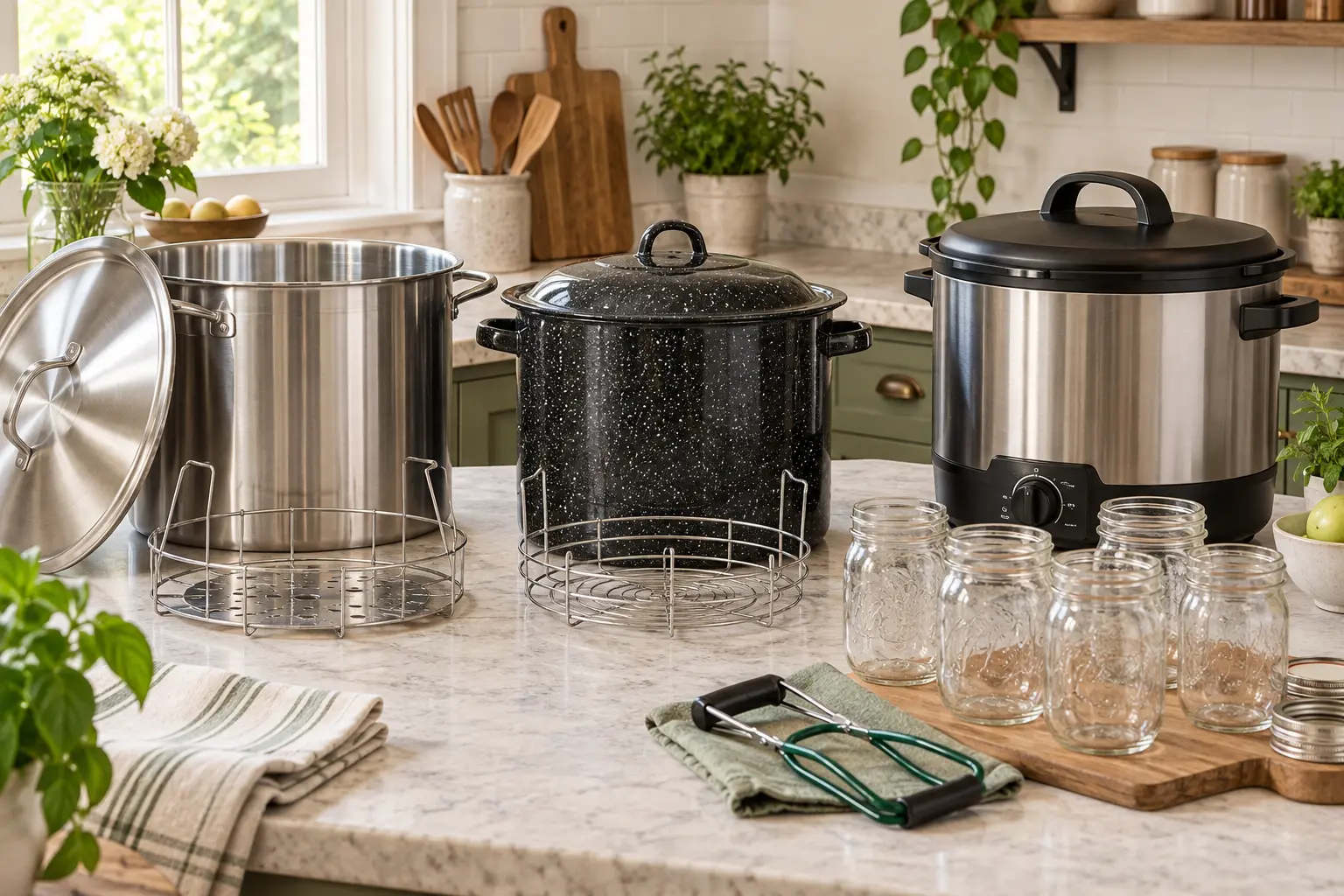
The best water-bath canner is not necessarily the most expensive pot. It is the vessel that safely fits your tested jar size, keeps jars on a rack, maintains the required water depth at a vigorous boil, works with your heat source, and can be handled without unsafe lifting.
Our water-bath canner picks
| Best for | Option | Key reason | Important limitation |
|---|---|---|---|
| Most households | VEVOR 21-quart stainless water-bath canner | Full-size stainless construction with rack and lid | Confirm jar clearance and cooktop compatibility before ordering |
| Small batches | VEVOR 15-quart stainless water-bath canner | Smaller footprint and stainless construction | Reduced height and batch capacity; verify the jars remain fully covered |
| Budget stovetop | Traditional 21.5-quart enamel canner | Lightweight, familiar design and broad availability | Enamel can chip; many models are unsuitable for induction |
| Countertop convenience | Ball EasyCanner electric water-bath canner | Dedicated electric heat source and drain-spout convenience | Use only according to Ball’s current appliance and recipe instructions |
| Occasional pint batches | Farberware 12-quart stainless stockpot | A multipurpose pot that may work for appropriately sized jars | Add a rack and verify required water depth and boiling clearance |
Best overall: VEVOR 21-quart stainless water-bath canner
The VEVOR 21-quart stainless water-bath canner is the strongest general-purpose option in the current affiliate catalog. Its larger capacity, included rack, and stainless construction make it better suited to regular preserving than a shallow household pot.
Stainless steel avoids the chipping risk of enamel and is easy to inspect and clean. The glass lid can help users monitor the return to boiling without repeatedly lifting the cover. Before purchase, compare the canner’s base material and diameter with the requirements of your gas, electric-coil, smooth-top, or induction range.
Best for: households that can several batches each season and want a dedicated stovetop canner.
Best compact stainless option: VEVOR 15-quart
The VEVOR 15-quart stainless water-bath canner uses less storage space and may heat more quickly than a larger vessel. It is most appealing for half-pint and pint batches of jam, jelly, salsa, chutney, and pickles.
Compact size is also its central limitation. The jars must sit upright on a rack and remain covered by the water depth stated in the tested recipe throughout processing, with additional space to prevent boiling over. Do not rely solely on a seller’s jar-count claim; measure your actual jars and usable interior height.
Best for: small households, limited storage, and frequent small-batch preserving.
Best budget option: traditional enamel canner
A 21- to 21.5-quart porcelain-enamel canner remains a practical entry point. These familiar speckled pots are light for their volume, typically include a jar rack, and are widely sold through hardware, farm, and general retailers.
The tradeoffs are durability and cooktop compatibility. Inspect enamel before every use and retire a pot with damage that compromises the interior surface or safe cleaning. A ridged or uneven base may perform poorly on a smooth-top range, and ordinary enamel steel is not automatically compatible with every induction system.
Best for: budget-conscious beginners using a compatible gas or electric-coil stove.
Best countertop electric option: Ball EasyCanner
The Ball EasyCanner is a dedicated 21-quart electric water-bath appliance currently listed by Ball. It can free a stovetop burner and may simplify draining and batch management.
Countertop appliances should not be treated as generic replacements for every tested process. Use the exact appliance instructions, confirm the permitted jar sizes and recipes, and apply altitude guidance as directed by Ball. Do not confuse an electric water-bath canner with an electric pressure cooker or assume it can process low-acid foods.
Best for: users who want a dedicated electric heat source and will follow the manufacturer’s current process instructions.
Best multipurpose stockpot: Farberware 12-quart
The Farberware 12-quart stainless stockpot can be considered for appropriately sized small batches when fitted with a rack. Its main advantage is versatility: it can remain useful for ordinary cooking outside
Do not assume a 12-quart capacity automatically makes it a canner. Place the tallest jar permitted by your recipe on the rack, then verify the pot can hold the required water above the lid while leaving enough space for a vigorous covered boil. If it cannot, choose a deeper pot.
Best for: occasional half-pint or pint batches where measurements confirm adequate clearance.
How to choose a safe water-bath canner
1. Measure jar height, not just pot volume
A pot’s quart capacity does not reveal its usable
2. Require a rack
Jars must not rest directly on the bottom. A rack allows water circulation and reduces thermal stress. It must keep jars upright and should not let small jars tip or slip through large openings.
3. Match the base to the cooktop
- Gas: supports many pot materials, but flames should not extend dangerously beyond the base.
- Electric coil: use a stable, reasonably flat-bottomed pot that does not grossly exceed the burner guidance.
- Smooth-top radiant: check the range manual for
canning , weight, diameter, and flat-bottom restrictions. - Induction: the base must be magnetic and suitable for the induction element; “stainless steel” alone does not guarantee compatibility.
4. Consider filled weight
A full canner is heavy. Confirm that the cooktop can support it and that you can fill, drain, and clean the vessel safely. A drain spout may reduce lifting, but it must be heat-safe, securely closed during processing, and maintained according to the manufacturer.
5. Choose a manageable batch size
A larger canner can improve throughput but uses more water, takes longer to heat, and requires more storage. A smaller canner is efficient only when it still meets the tested process requirements.
Can any stockpot be used for water-bath canning ?
A deep stockpot can work when it has a fitted lid, a stable rack, adequate jar and water clearance, and compatibility with the heat source. The pot must maintain continuous boiling for the entire scheduled processing time. Never improvise with a shallow vessel that exposes jar lids during boiling.
What foods belong in a water-bath canner?
Use a tested boiling-water process for products such as properly acidified pickles, many fruits, jams, jellies, relishes, acidified tomatoes, and tested salsas. Recipe formulation matters: adding extra low-acid vegetables, reducing vinegar, changing jar size, or increasing density can invalidate the process.
Water-bath versus atmospheric steam canning
An atmospheric steam canner is a separate appliance and process. Current research-based guidance permits it only for suitable high-acid foods when all stated limitations are met, including process duration and altitude adjustments. Do not apply water-bath instructions to steam equipment without authoritative guidance.
Features worth paying for
- Reliable rack sized for both the pot and intended jars
- Flat, stable base compatible with the cooktop
- Durable handles with safe clearance from heat
- Fitted lid
- Interior depth adequate for quart jars, if you plan to process quarts
- Replacement-rack availability
- Drain spout on large or electric models, when safely designed
Features that do not replace safety requirements
- A thermometer does not make an untested recipe safe.
- A glass lid does not prove that every jar stayed adequately covered.
- A digital controller does not turn a water-bath appliance into a pressure canner.
- A large advertised jar count does not guarantee correct spacing or water depth.
- A vacuum seal does not prove adequate processing.
Our recommendation
For most beginners, choose a full-size stovetop canner with a rack, lid, adequate depth, and verified cooktop compatibility. The VEVOR 21-quart stainless model is the most versatile managed-affiliate option currently cataloged on this site. Choose the 15-quart model only after confirming it fits your intended jars and water depth. A traditional enamel canner remains the simplest budget choice, while the Ball electric model suits users prioritizing countertop convenience.
Trusted safety references
- NCHFP: Recommended Canners
- NCHFP: Selecting the Correct Processing Time
- Boiling-Water Canner Equipment Guide
- Complete Beginner Canning Tools Checklist
- Canning Jars and Lids Buying Guide
Product and safety review: September 2026. Check current manufacturer specifications, your cooktop manual, and the tested recipe before purchase or use.