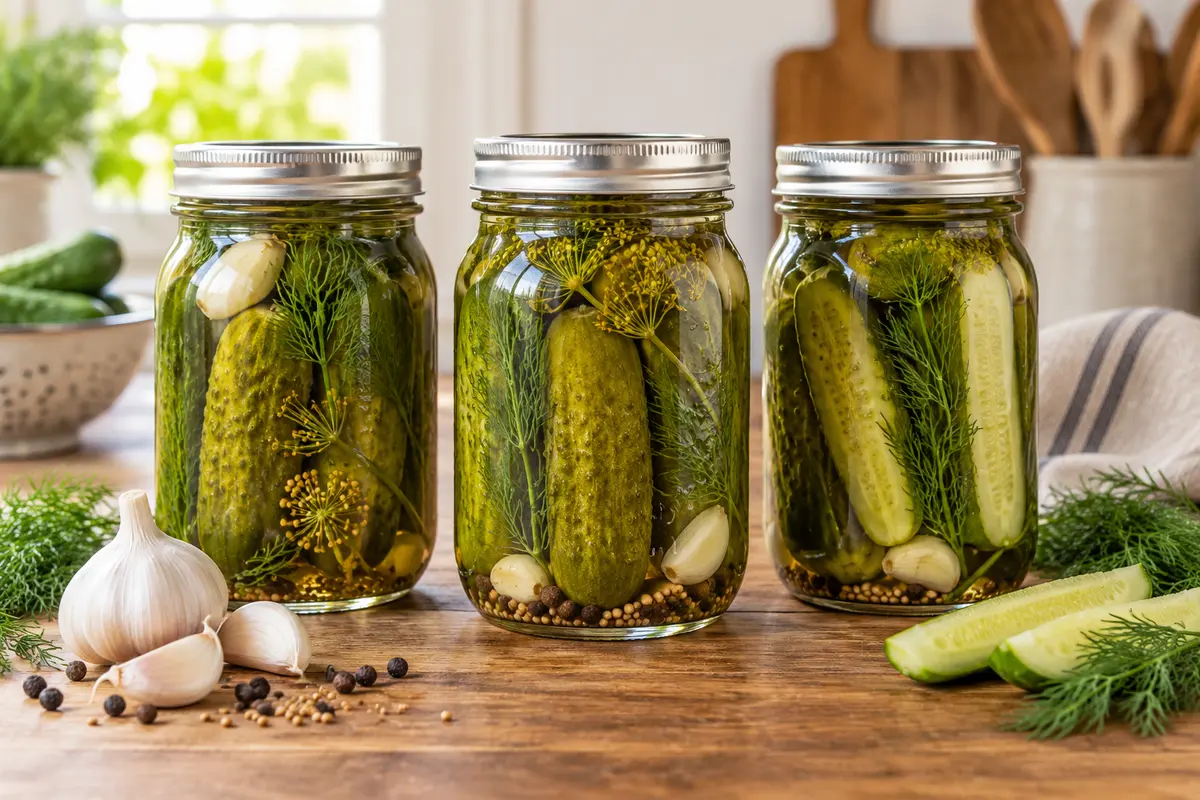
(function(){function place(){var root=document.currentScript&&document.currentScript.parentElement;if(!root)return;var card=root.querySelector(‘.wprm-recipe-snippet,.wprm-recipe-container’);var nav=root.querySelector(‘.recipe-quick-nav’);if(card&&nav&&card.nextElementSibling!==nav)root.insertBefore(card,nav);}if(document.readyState===’loading’)document.addEventListener(‘DOMContentLoaded’,place);else place();})();
Dill pickles (fermented) — NCHFP
Ingredients
- 4 lbs 4-inch pickling cucumbers
- 2 tbsp dill seed or 4 to 5 heads fresh or dry dill weed
- 1/2 cup salt
- 1/4 cup vinegar (5 percent)
- 8 cups water and one or more of the following ingredients: 2 cloves garlic (optional)
- 2 dried red peppers (optional)
- 2 tsp whole mixed pickling spices (optional)
Equipment
- 1 Boiling-water bath canner with rack
- 1 Large stainless or enamel preserving pot
- 1 Canning jars with two-piece lids
- 1 Headspace and bubble tool
Directions
- Wash cucumbers. Cut 1/16-inch slice off blossom end and discard. Leave 1/4-inch of stem attached. Place half of dill and spices on bottom of a clean, suitable container. For more information on containers see "Suitable Containers, Covers, and Weights for Fermenting Food," .
- Add cucumbers, remaining dill, and spices. Dissolve salt in vinegar and water and pour over cucumbers. Add suitable cover and weight. Store where temperature is between 70 F and 75 F for about 3 to 4 weeks while fermenting.
- Temperatures of 55 to 65 F are acceptable, but the fermentation will take 5 to 6 weeks. Avoid temperatures above 80 F, or pickles will become too soft during fermentation. Fermenting pickles cure slowly. Check the container several times a week and promptly remove surface scum or mold.
- Caution: If the pickles become soft, slimy, or develop a disagreeable odor, discard them. Fully fermented pickles may be stored in the original container for about 4 to 6 months, provided they are refrigerated and surface scum and molds are removed regularly.
- Canning fully fermented pickles is a better way to store them. To can them, pour the brine into a pan, heat slowly to a boil, and simmer 5 minutes. Filter brine through paper coffee filters to reduce cloudiness, if desired. Fill jar with pickles and hot brine, leaving 1/2-inch headspace.
- Adjust lids and process as recommended in
- Processing: Process Raw, Pints, boiling-water canner, 0 - 1,000 ft - 10 minutes.
- Altitude-adjusted processing table: Table 1. Recommended process time for Dill Pickles in a boiling-water canner. / Process Time at Elevations of / Style of Pack - Jar Size - 0 - 1,000 ft - 1,001 - 6,000 ft - Above 6,000 ft / Raw - Pints - 10 min - 15 - 20 / Quarts - 15 - 20 - 25
Recipe Notes
Private Notes
Questions or results?
Discuss this recipe with the canning community. Community comments do not replace the tested source or safety classification shown on this page.
Join the discussion
Please log in or create a free account to discuss this recipe. You will return here afterward.
Tried this recipe?
Share your results how it turned out.Safety classification
Tested NCHFP home-canning recipe.
Processing details
Method: Boiling water bath. Ferment 3–6 weeks under controlled temperature, then raw-pack fully fermented pickles; pint or quart jars; 1/2-inch headspace.
Tested source
Preparation timeline
Prepare cucumbers and brine; ferment at 70–75°F for about 3–4 weeks or 55–65°F for 5–6 weeks; inspect regularly; heat brine; pack fully fermented pickles; process.
Equipment
Food-safe fermentation container, suitable cover and weights, thermometer, boiling-water canner, pint or quart jars, jar lifter, and funnel.
Visual method guide
- Prepare and measure ingredients exactly.
- Complete the tested cooking or fermentation stage.
- Fill, process by elevation, and cool undisturbed.
Safety essentials
Do not reduce salt or 5% vinegar. Avoid fermentation above 80°F. Discard pickles that become soft, slimy, or develop a disagreeable odor.
About this recipe
Traditional dill pickles fermented in a salt-and-vinegar brine before optional shelf-stable
Before you begin
Remove 1/16 inch from blossom ends and leave 1/4 inch of stem. Keep cucumbers submerged beneath brine throughout fermentation.
Altitude/pressure schedule
| Elevation | Pints | Quarts |
|---|---|---|
| 0–1,000 ft | 10 min | 15 min |
| 1,001–6,000 ft | 15 min | 20 min |
| Above 6,000 ft | 20 min | 25 min |
Serving suggestions
Chill and serve with sandwiches, burgers, salads, or snack boards.
FAQ
How long does fermentation take? About 3–4 weeks at 70–75°F or 5–6 weeks at 55–65°F.
Recipe context and comparison
Fermentation happens before
Troubleshooting
Remove surface scum or mold promptly. Discard the batch for softness, slime, or an unpleasant odor rather than attempting to can it.
Source and provenance
Safety-critical values remain tied to the original NCHFP source.
Garden planning for this recipe
Plant, space, variety, zone, and timing estimates live on dedicated ingredient pages: