Safety classification
Tested
Testing authority: National Center for Home Food Preservation
Safety reviewed: 09/18/2026
Processing details
Altitude adjustment: Use the exact altitude-adjusted schedule in the tested recipe card.
Source & provenance
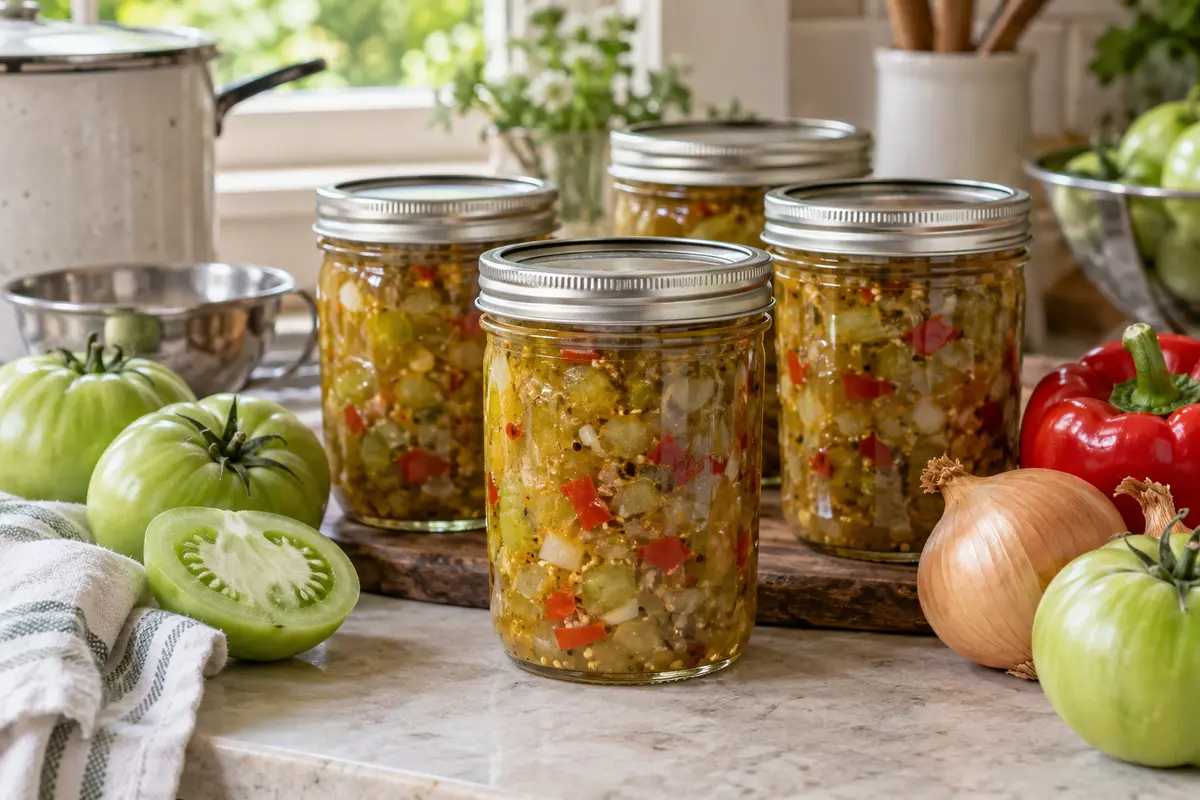
(function(){function p(){var e=document.querySelector(“#post-4752 .entry-content”),s=e&&e.querySelector(“.wprm-recipe-snippet,.wprm-recipe-container”),n=e&&e.querySelector(“#recipe-quick-nav”);if(e&&s&&n&&s.nextElementSibling!==n)e.insertBefore(s,n);}if(document.readyState===”loading”)document.addEventListener(“DOMContentLoaded”,p);else p();setTimeout(p,250);})();
Safety classification
Tested recipe. Documented by National Center for Home Food Preservation.
Processing details
- Method: Boiling-water
canning ; hot pack - Jar size: Pints
- Headspace: 1/2 inch
- Processing: 5 minutes at 0–1,000 ft; use the source/card’s altitude adjustments above 1,000 ft.
Tested/documented source
National Center for Home Food Preservation: Pickled Green Tomato Relish — NCHFP. The source and recipe card remain authoritative for quantities and processing.
Preparation timeline
- Prepare jars, canner, produce, and measured ingredients.
- Prepare and salt the vegetables as directed, drain, cook in the tested vinegar mixture, then hot-pack promptly.
- Fill jars, adjust headspace, process for elevation, and cool undisturbed 12–24 hours.
Equipment
- Boiling-water canner with rack
- Pints with compatible lids and bands
- Large nonreactive preserving pot
- Jar lifter,
canning funnel, and bubble/headspace tool
Visual method guide
- Prepare ingredients uniformly.
- Cook the full tested mixture as directed.
- Hot-pack evenly and maintain 1/2 inch headspace.
- Process using the documented altitude schedule.
Safety essentials
Use vinegar labeled 5% acidity and the complete tested proportions. Because the base process is 5 minutes, use pre-sterilized jars when following that schedule.
Do not enlarge jar size or shorten processing time. Refrigerate any unsealed jar.
About this recipe
A tested hot-pack green-tomato relish for pint jars.
Before you begin
Read the complete recipe card and source, measure every ingredient before cooking, confirm your elevation, and prepare only one tested batch at a time.
Altitude-adjusted processing
5 minutes at 0–1,000 ft; use the source/card’s altitude adjustments above 1,000 ft.
Maintain a full rolling boil throughout processing; restart timing if boiling stops.
Pickled green tomato relish — NCHFP
Ingredients
- 10 lbs small, hard green tomatoes
- 1-1/2 lbs red bell peppers
- 1-1/2 lbs green bell peppers
- 2 lbs onions
- 1/2 cup canning or pickling salt
- 1 qt water
- 4 cups sugar
- 1 qt vinegar (5 percent)
- 1/3 cup prepared yellow mustard
- 2 tbsp cornstarch
Equipment
- 1 Boiling-water bath canner with rack
- 1 Large stainless or enamel preserving pot
- 1 Canning jars with two-piece lids
- 1 Headspace and bubble tool
Directions
- Wash and coarsely grate or finely chop tomatoes, peppers, and onions. Dissolve salt in water and pour over vegetables in large kettle. Heat to boiling and simmer 5 minutes. Drain in colander. Return vegetables to kettle. Add sugar, vinegar, mustard, and cornstarch. Stir to mix.
- Heat to boil and simmer 5 minutes. Fill sterile pint jars with hot relish, leaving 1/2-inch headspace. For more information see "Sterilization of Empty Jars" . Adjust lids and process according to the recommendations in
- Processing: Process Hot, Pints, boiling-water canner, 0 - 1,000 ft - 5 minutes.
- Altitude-adjusted processing table: Table 1. Recommended process time for Pickled Green Tomato Relish in a boiling-water canner. / Process Time at Elevations of / Style of Pack - Jar Size - 0 - 1,000 ft - 1,001 - 6,000 ft - Above 6,000 ft / Hot - Pints - 5 min - 10 - 15
Recipe Notes
Private Notes
Questions or results?
Discuss this recipe with the canning community. Community comments do not replace the tested source or safety classification shown on this page.
Join the discussion
Please log in or create a free account to discuss this recipe. You will return here afterward.
Tried this recipe?
Share your results how it turned out.Serving suggestions
Serve with meats, beans, sandwiches, or savory dishes.
Frequently asked questions
Can I change the jar size?
No. Use only the jar sizes documented by the tested source.
Can I change the vinegar, fruit, vegetables, or sugar?
Do not alter the tested formulation for shelf-stable
Recipe context
This cooked, acidified relish is not interchangeable with plain canned green tomatoes or refrigerator relish.
Troubleshooting
Seal failure: Refrigerate the jar; do not store it at room temperature.
Liquid loss: Allow jars to cool undisturbed, then inspect the seal and food before storage. Discard spoiled product without tasting.
Source and provenance
Primary source: National Center for Home Food Preservation. Editorial organization changes only; the tested formula and safety requirements remain in the recipe card.