(function(){function place(){var root=document.currentScript&&document.currentScript.parentElement;if(!root)return;var card=root.querySelector(‘.wprm-recipe-snippet,.wprm-recipe-container’);var nav=root.querySelector(‘.recipe-quick-nav’);if(card&&nav&&card.nextElementSibling!==nav)root.insertBefore(card,nav);}if(document.readyState===’loading’)document.addEventListener(‘DOMContentLoaded’,place);else place();})();
Plum jelly (with liquid or powdered pectin) — NCHFP
Ingredients
- 4 cups plum juice (about 4 1/2 pounds plums and 1/2 cup water)
- 7 1/2 cups sugar
- 1 pouch liquid pectin
Equipment
- 1 Boiling-water bath canner with rack
- 1 Large stainless or enamel preserving pot
- 1 Canning jars with two-piece lids
- 1 Headspace and bubble tool
- 1 Jelly or candy thermometer
Directions
- Sterilize canning jars and prepare two-piece canning lids according to manufacturer s directions. To prepare juice. Sort and wash fully ripe plums and cut in pieces; do not peel or pit. Crush fruit, add water, cover, and bring to boil over high heat. Reduce heat and simmer for 10 minutes.
- Extract juice. To make jelly. Measure juice into a kettle. Stir in sugar. Place on high heat and, stirring constantly, bring quickly to a full rolling boil that cannot be stirred down. Add pectin and heat again to a full rolling boil. Boil hard for 1 minute. Remove from heat; skim off foam quickly.
- Pour hot jelly immediately into hot, sterile jars, leaving 1/4 inch headspace. Wipe rims of jars with a dampened clean paper towel; adjust two-piece metal canning lids. Process in a Boiling Water Canner .
- Processing: Process Hot, Half-pints or Pints, boiling-water canner, 0 - 1,000 ft - 5 minutes.
- Altitude-adjusted processing table: Table 1. Recommended process time for Plum Jelly in a boiling water canner. / Process Time at Elevations of / Style of Pack - Jar Size - 0 - 1,000 ft - 1,001 - 6,000 ft - Above 6,000 ft / Hot - Half-pints / / or Pints - 5 min - 10 - 15
Recipe Notes
Private Notes
Questions or results?
Discuss this recipe with the canning community. Community comments do not replace the tested source or safety classification shown on this page.
Join the discussion
Please log in or create a free account to discuss this recipe. You will return here afterward.
Tried this recipe?
Share your results how it turned out.Safety classification
Tested NCHFP home-canning recipe.
Processing details
Method: Boiling water bath. Hot pack; half-pint or pint jars; 1/4-inch headspace; about 7–8 half-pints.
Tested source
Preparation timeline
Crush cut plums with water; simmer 10 minutes; extract and measure juice; add sugar; boil; add liquid pectin and boil hard 1 minute; fill sterile jars; process.
Equipment
Boiling-water canner, half-pint or pint jars, jelly bag, jar lifter, funnel, and preserving kettle.
Visual method guide
- Prepare and measure fruit or juice exactly.
- Cook to the tested boil or jellying endpoint.
- Fill, process by elevation, and cool undisturbed.
Safety essentials
Use the exact plum-juice, sugar, and liquid-pectin proportions. Do not interchange liquid and powdered pectin without the matching tested formula.
About this recipe
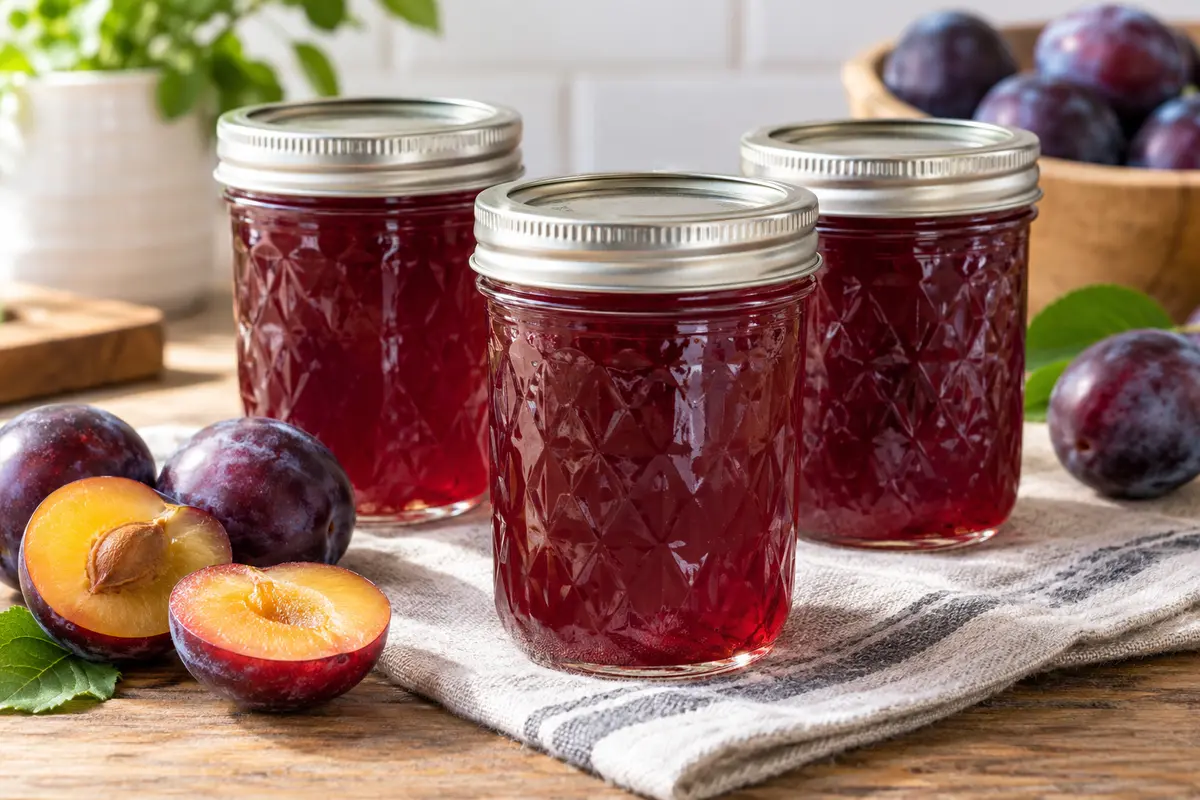
A clear ruby plum jelly prepared from extracted juice and liquid pectin.
Before you begin
Sterilize jars because the base process is 5 minutes. Cut plums without peeling or pitting before the juice-extraction simmer, as the source directs.
Altitude/pressure schedule
| Elevation | Half-pints or pints |
|---|---|
| 0–1,000 ft | 5 min |
| 1,001–6,000 ft | 10 min |
| Above 6,000 ft | 15 min |
Serving suggestions
Serve on toast, biscuits, cheese, or use as a glaze.
FAQ
Can powdered pectin be substituted directly? No. Pectin forms require different tested quantities and order of addition.
Recipe context and comparison
Unlike plum jam, this jelly strains out pulp and skins before cooking with sugar and pectin.
Troubleshooting
Avoid squeezing the jelly bag for best clarity; reach a full rolling boil after adding pectin.
Source and provenance
Safety-critical values remain tied to the original NCHFP source.
Garden planning for this recipe
Plant, space, variety, zone, and timing estimates live on dedicated ingredient pages: