Safety classification
Tested
Testing authority: National Center for Home Food Preservation (University of Georgia / USDA-derived guidance)
Safety reviewed: 09/09/2026
Processing details
Altitude adjustment: Dial gauge: 11 psi at 0–2,000 ft; 12 psi at 2,001–4,000 ft; 13 psi at 4,001–6,000 ft; 14 psi at 6,001–8,000 ft. Weighted gauge: 10 psi at 0–1,000 ft; 15 psi above 1,000 ft.
Source & provenance
Safety classification: Tested recipe from NCHFP.
King or Dungeness crab meat canning safety
| Method | Pressure |
|---|---|
| Pack | Hot prepared and acid-treated crab meat |
| Jar sizes | Half-pints or pints only |
| Headspace | 1 inch |
| Yield/limit | For King or Dungeness crab; freeze blue crab for best quality |
Safety boundary: Both acid treatments, exact meat weights, jar limits, and the full pressure schedule are required; do not use blue crab.
Processing details
- Method
- Pressure
- Pack style
- Hot
- Jar sizes
- Half-Pint or Pint Jars
- Headspace
- 1 inch
- Processing time
- Half-pints: 70 min; Pints: 80 min
Tested recipe source: National Center for Home Food Preservation (NCHFP)
King or Dungeness crab meat timeline
- Prepare: Use King or Dungeness crab and complete the tested meat weights and acid soak.
- Pack: Add the required per-jar citric acid or lemon juice, fill with hot water, and leave 1-inch headspace.
- Process: Pressure-can half-pints 70 minutes or pints 80 minutes.
Equipment for king or dungeness crab meat
Affiliate disclosure: Equipment links may earn a commission at no added cost; safety guidance is independent.
- Pressure canner with rack and tested dial or weighted gauge
- Half-pints or pints only Mason jars with two-piece lids
- Large pot,
canning funnel, jar lifter, headspace tool, and bubble remover
Visual method guide
- Prepare only King or Dungeness crab meat.
- Complete the required acid soak.
- Add the required per-jar acid and hot water.
- Use half-pints or pints and pressure-can for the matching time.
The official source and WPRM recipe card remain authoritative.
Safety essentials
Tested NCHFP pressure-canning procedure. Retain every acid-treatment step. Blue crab is outside this recipe and is preferably frozen for quality.
What is king or dungeness crab meat?
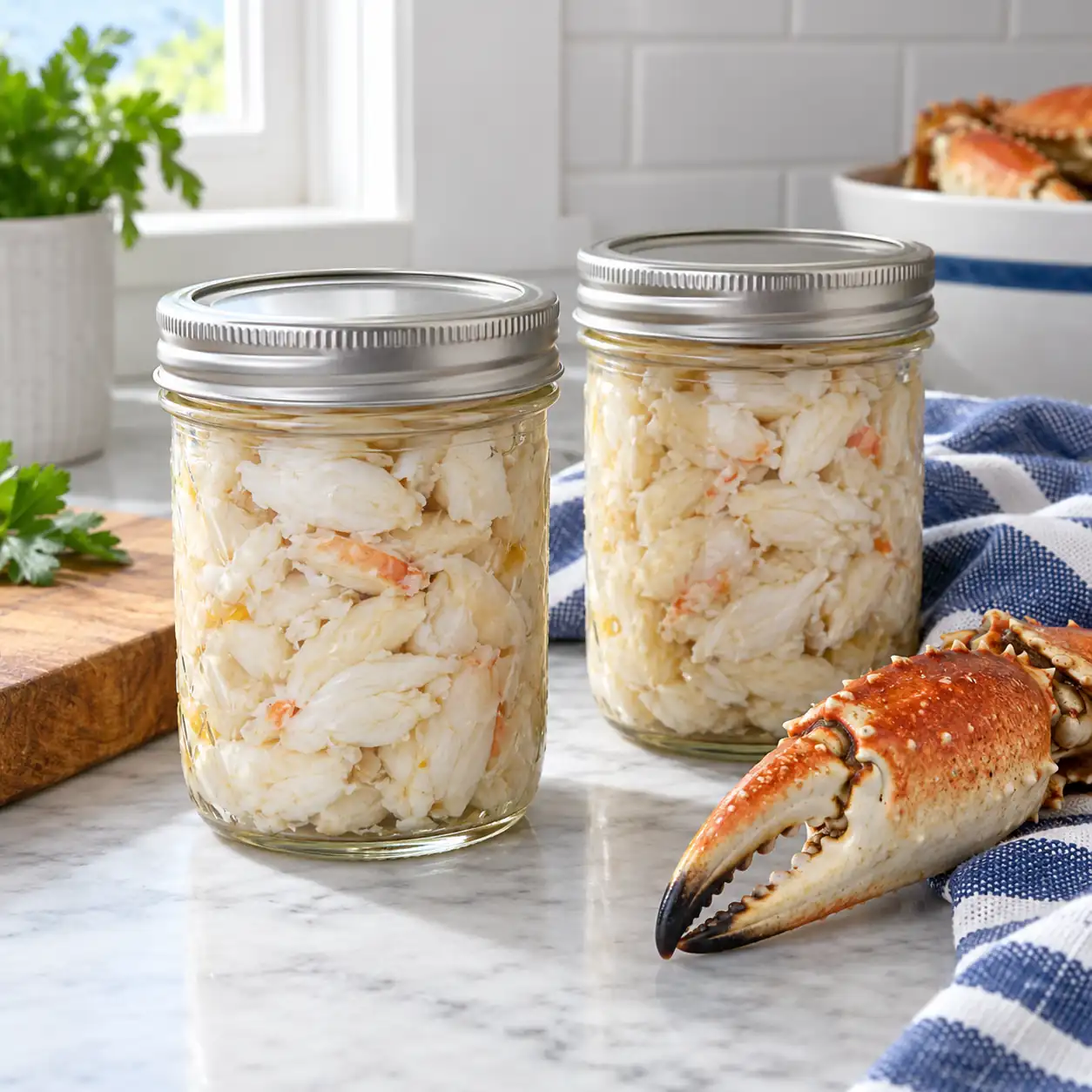
This specialized process pressure cans acid-treated King or Dungeness crab meat.
Before you begin
- Do not use blue crab under this process.
- Complete both the acid soak and per-jar acid addition.
- The finished flavor may be distinctly acidic.
Altitude-adjusted pressure schedule
| Jar/product | Time | 0–2,000 ft | 2,001–4,000 ft | 4,001–6,000 ft | 6,001–8,000 ft |
|---|---|---|---|---|---|
| Half-pints | 70 min | 11 psi | 12 psi | 13 psi | 14 psi |
| Pints | 80 min | 11 psi | 12 psi | 13 psi | 14 psi |
| Jar/product | Time | 0–1,000 ft | Above 1,000 ft |
|---|---|---|---|
| Half-pints | 70 min | 10 psi | 15 psi |
| Pints | 80 min | 10 psi | 15 psi |
Crab Meat, King and Dungeness — NCHFP
Ingredients
- live King or Dungeness crabs keep on ice until ready to can
- 1/4 cup lemon juice per gallon of initial simmering water
- 2 tbsp salt per gallon of initial simmering water; up to 1 cup may be used if desired
- 2 cups lemon juice per gallon of cold soaking water; OR use 4 cups white vinegar
- 2 tbsp salt per gallon of soaking water; up to 1 cup may be used if desired
- 1/2 tsp citric acid per half-pint jar; OR 2 tablespoons lemon juice
- 1 tsp citric acid per pint jar; OR 4 tablespoons lemon juice
- hot water for filling jars
Equipment
- 1 Pressure canner Dial- or weighted-gauge pressure canner appropriate for altitude.
- As needed Canning jars Half-pints or pints only.
- As needed Two-piece canning lids Use new flat lids and prepare according to manufacturer directions.
Directions
- Keep live crabs on ice until ready to can. Wash thoroughly in several changes of cold water.
- Simmer crabs 20 minutes in water containing 1/4 cup lemon juice and 2 tablespoons salt per gallon. Cool in cold water, drain, remove the back shell, and remove meat from the body and claws.
- Soak the meat for 2 minutes in cold water containing 2 cups lemon juice or 4 cups white vinegar plus 2 tablespoons salt per gallon. Drain and squeeze out excess moisture.
- Pack 6 ounces of crab meat in each half-pint jar or 12 ounces in each pint jar, leaving 1-inch headspace.
- Add 1/2 teaspoon citric acid or 2 tablespoons lemon juice to each half-pint; add 1 teaspoon citric acid or 4 tablespoons lemon juice to each pint. Add hot water, maintaining 1-inch headspace.
- Pressure process half-pints for 70 minutes and pints for 80 minutes.
- Dial gauge: 11/12/13/14 psi at 0–2,000/2,001–4,000/4,001–6,000/6,001–8,000 ft. Weighted gauge: 10 psi through 1,000 ft and 15 psi above 1,000 ft.
Recipe Notes
Private Notes
Questions or results?
Discuss this recipe with the canning community. Community comments do not replace the tested source or safety classification shown on this page.
Join the discussion
Please log in or create a free account to discuss this recipe. You will return here afterward.
Tried this recipe?
Share your results how it turned out.How to serve king or dungeness crab meat
Drain and use in crab cakes, dips, soups, salads, pasta, and casseroles.
King or Dungeness crab meat questions
Why are there two acid treatments?
Both are part of the tested process and must not be reduced or omitted.
Can I use a boiling-water canner?
No. This low-acid food requires pressure
What if pressure drops?
Restore the required pressure and restart the full processing time.
King/Dungeness crab versus blue crab
This process is specifically for King and Dungeness crab; NCHFP recommends freezing blue crab meat for best quality.
King or Dungeness crab meat troubleshooting
Why does the canned crab taste acidic?
That is an expected quality effect of the required acid treatments; never reduce the acid.
What if a jar does not seal?
Refrigerate promptly or follow authoritative reprocessing guidance within the permitted time.
Source & provenance
NCHFP, “Crab Meat, King and Dungeness”. Official NCHFP/USDA tested seafood process.
Editorial review: Supporting blocks checked against the official source on September 20, 2026. The WPRM recipe card was preserved.
Typical canning season
Season: All Year
Months: January, February, March, April, May, June, July, August, September, October, November, December
How much of the main ingredient should I grow?
Not applicable as a garden crop; plan purchases or harvest separately
This recipe does not have a reliable garden conversion. Plan a purchase or harvest separately, and do not use garden estimates to alter the tested recipe.
Garden yields vary by cultivar, climate, soil, pests, and care. Always measure the exact prepared ingredient amount required by the tested canning recipe.