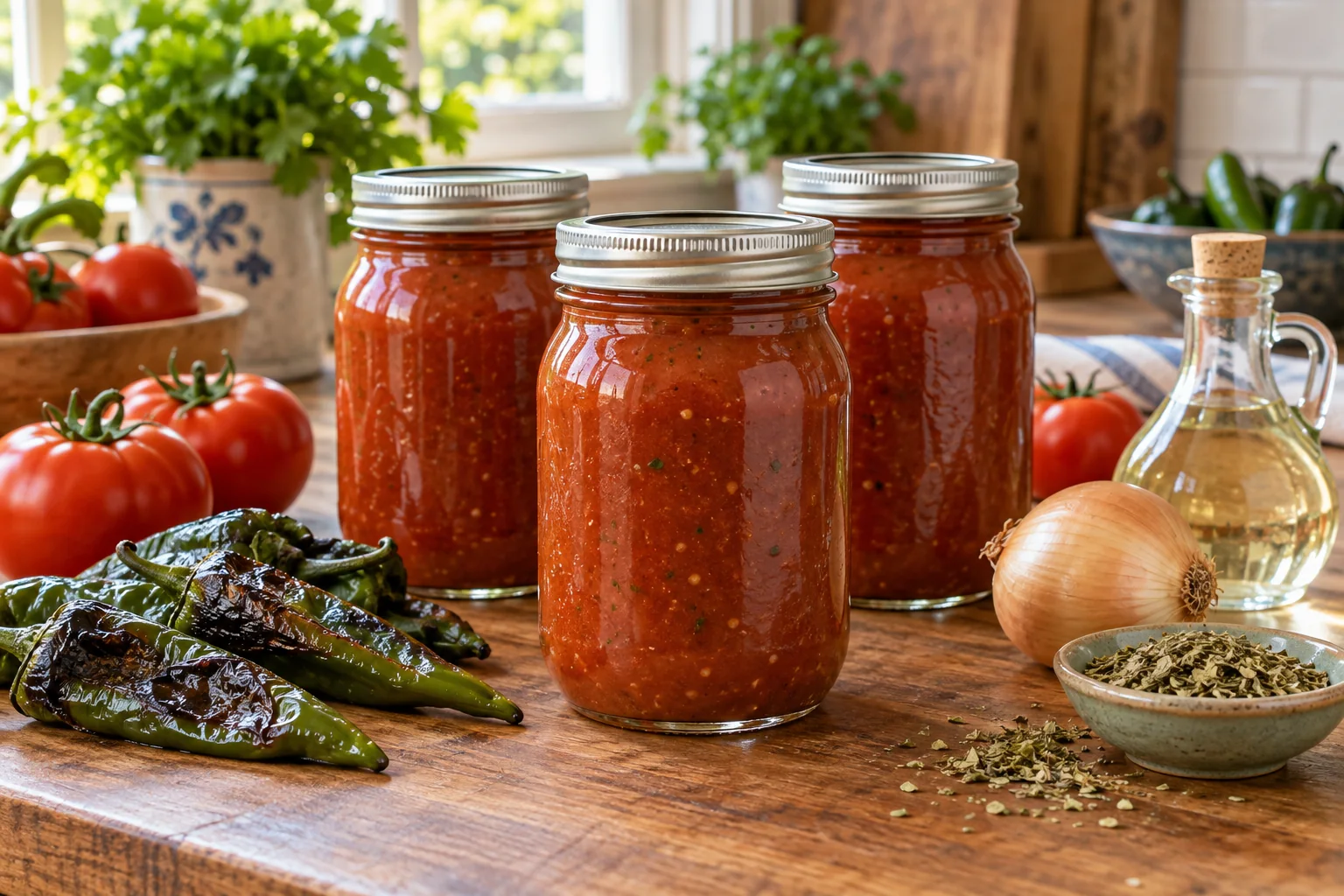
Mexican Tomato Sauce — NCHFP
Ingredients
- 2 1/2 to 3 pounds chile peppers washed, blistered, peeled, seeded and chopped
- 18 pounds tomatoes peeled, cored and coarsely chopped
- 3 cups onions chopped
- 1 tablespoon salt
- 1 tablespoon oregano
- 1/2 cup vinegar
Equipment
- 1 Pressure canner Dial-gauge or weighted-gauge model.
- 7 Quart canning jars The source also provides a pint process; use the time for the selected jar size.
- 1 Nonmetallic bubble remover
Directions
- Read the pressure-canner manufacturer's instructions and the linked NCHFP pressure-canning guide. Wear gloves while handling hot peppers and keep your hands away from your face and eyes.
- Wash and dry the chiles. Slit each one so steam can escape. Blister skins for 6–8 minutes in a 400°F oven or broiler, or over a burner protected by heavy wire mesh. Cool under a damp cloth, peel, discard seeds and chop.
- Wash the tomatoes. Dip them in boiling water for 30–60 seconds, until skins split, then transfer them to cold water. Slip off skins, remove cores and chop coarsely.
- Combine the prepared tomatoes and chiles with the onions, salt, oregano and vinegar in a large saucepan. Bring to a boil, cover and simmer for 10 minutes.
- Fill hot jars with hot sauce, leaving 1 inch headspace. Release trapped air, restore headspace, wipe rims and fit lids.
- Dial-gauge canner: process pints for 20 minutes or quarts for 25 minutes at 11 psi from 0–2,000 feet; 12 psi at 2,001–4,000 feet; 13 psi at 4,001–6,000 feet; or 14 psi at 6,001–8,000 feet.
- Weighted-gauge canner: process pints for 20 minutes or quarts for 25 minutes at 10 psi from 0–1,000 feet or 15 psi above 1,000 feet.
- When processing ends, turn off the heat and let the canner depressurize naturally. Do not force cooling. Follow the canner manufacturer's opening directions, then lift jars upright and cool undisturbed for 12–24 hours before checking seals.
Recipe Notes
Private Notes
Questions or results?
Discuss this recipe with the canning community. Community comments do not replace the tested source or safety classification shown on this page.
Join the discussion
Please log in or create a free account to discuss this recipe. You will return here afterward.
Tried this recipe?
Share your results how it turned out.Safety classification
Tested recipe: National Center for Home Food Preservation. Method: Pressure
Processing details
Method: Pressure
- Pack: Hot pack
- Jar size: Pint or quart jars
- Headspace: 1 inch
- Yield: About 7 quarts
Tested source
Preparation timeline
Prepare and cook the sauce; vent the pressure canner for 10 minutes; process at the altitude-correct pressure; cool naturally.
Equipment
Pressure canner with accurate gauge, pint or quart jars, jar lifter, funnel, bubble remover, and large nonreactive pot.
Visual method guide
- Prepare the canner, jars, and measured ingredients.
- Cook and fill jars using the tested recipe card.
- Process with the schedule below, then cool jars upright and undisturbed.
Safety essentials
This is a pressure-canning recipe. Do not substitute boiling-water processing or change the vegetable-to-acid proportions.
About this recipe
A seasoned tomato sauce with chiles and onions, processed as a low-acid mixture in a pressure canner.
Before you begin
Hot pack only. Use 1-inch headspace. Select the processing time for jar size and the pressure for your gauge and altitude.
Altitude/pressure schedule
| Dial-gauge elevation | Pressure | Pints | Quarts |
|---|---|---|---|
| 0–2,000 ft | 11 psi | 20 min | 25 min |
| 2,001–4,000 ft | 12 psi | 20 min | 25 min |
| 4,001–6,000 ft | 13 psi | 20 min | 25 min |
| 6,001–8,000 ft | 14 psi | 20 min | 25 min |
| Weighted-gauge elevation | Pressure | Pints | Quarts |
|---|---|---|---|
| 0–1,000 ft | 10 psi | 20 min | 25 min |
| Above 1,000 ft | 15 psi | 20 min | 25 min |
Serving suggestions
Use as a base for rice, beans, enchiladas, braises, or soups.
FAQ
Can this be water-bath canned? No. Use the pressure-canning process specified by the tested source.
Recipe context and comparison
Unlike acidified salsa recipes, this tomato-and-vegetable sauce uses pressure processing and allows both pint and quart jars.
Troubleshooting
If pressure drops below the target, bring the canner back to pressure and restart the full processing time. Let the canner depressurize naturally.
Source and provenance
Safety-critical formulation and processing values are tied to the original NCHFP source. Editorial blocks do not replace that source.
Garden planning for this recipe
Plant, space, variety, zone, and timing estimates live on dedicated ingredient pages:
Typical canning season
Season: All Year
Months: All Year
Main ingredient: Tomatoes
Basis: Editorial All Year fallback: no narrower main-ingredient season was specified.
How much of the main ingredient should I grow?
40–80 lb of Tomatoes per person per year
The source-cited calculator below can convert your pantry goal into foot of row, medium-onion plant estimates where compatible yield data exists.
Garden yields vary by cultivar, climate, soil, pests, and care. Always measure the exact prepared ingredient amount required by the tested canning recipe.