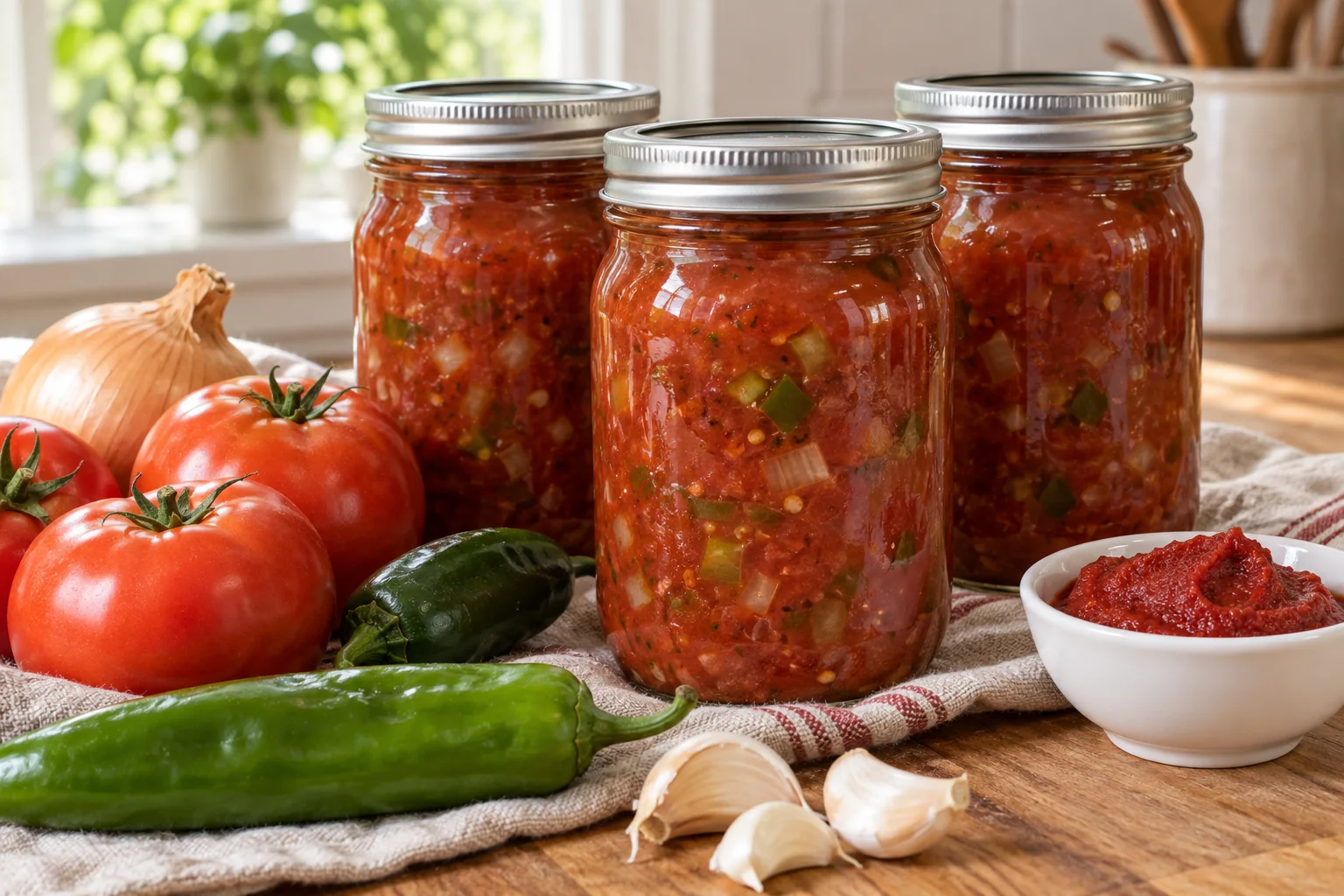
Tomato/Tomato Paste Salsa — NCHFP
Ingredients
- 3 quarts slicing tomatoes peeled, cored and chopped
- 3 cups onions chopped
- 6 jalapeño peppers seeded and finely chopped
- 4 long green chiles seeded and chopped
- 4 cloves garlic finely chopped
- 2 12-ounce cans tomato paste
- 2 cups bottled lemon or lime juice
- 1 tablespoon salt
- 1 tablespoon sugar
- 1 tablespoon ground cumin optional
- 2 tablespoons oregano leaves optional
- 1 teaspoon black pepper
Equipment
- 1 Boiling-water canner with rack
- 9 Pint canning jars Use lids and bands compatible with the jars.
- 1 Large saucepot Choose a pot with room for the full recipe and safe stirring.
- 1 Nonmetallic bubble remover
Directions
- Preheat the canner water to 180°F for hot-packed jars. Wash and rinse the jars, then keep them hot. Prepare lids and bands as their manufacturer directs. Wear gloves when handling hot peppers; keep your hands away from your eyes and face.
- Peel and core the slicing tomatoes, then chop and measure 3 quarts. Prepare the onions, garlic and seeded peppers as specified.
- If peeling the long green chiles, slit each pepper and blister its skin under a broiler or in a 400°F oven for 6–8 minutes. Cover with a damp cloth, cool, peel, discard seeds and chop. Finely chopped peppers may retain their skins; jalapeños need not be peeled.
- Combine all ingredients in a saucepan. Bring to a boil, stirring frequently. Reduce the heat and simmer for 30 minutes, stirring occasionally.
- Ladle hot salsa into hot pint jars, leaving 1/2 inch headspace. Release bubbles, restore headspace, clean the rims and fit lids.
- Use a rack and keep jars upright. Water must cover the lids by at least 1 inch, or 2 inches when processing longer than 30 minutes. Cover the canner; begin timing at a full boil and keep it boiling throughout. If boiling stops, bring it back to a boil and restart the full processing time.
- Process in boiling water: 15 minutes at 0–1,000 feet; 20 minutes at 1,001–6,000 feet; or 25 minutes above 6,000 feet. Follow the canner directions above.
- After processing, turn off the heat, remove the canner lid and wait 5 minutes. Lift jars out upright onto a towel or cooling rack. Leave undisturbed for 12–24 hours, then check seals. Refrigerate unsealed jars and use them first. Remove bands from sealed jars, clean and label them, and store in a cool, dry place away from sunlight.
Recipe Notes
Private Notes
Questions or results?
Discuss this recipe with the canning community. Community comments do not replace the tested source or safety classification shown on this page.
Join the discussion
Please log in or create a free account to discuss this recipe. You will return here afterward.
Tried this recipe?
Share your results how it turned out.Safety classification
Tested recipe: National Center for Home Food Preservation. Method: Boiling-water
Processing details
Method: Boiling-water
- Pack: Hot pack
- Jar size: Pint jars
- Headspace: 1/2 inch
- Yield: About 7–9 pints
Tested source
Preparation timeline
Prepare and measure produce; cook the salsa to the tested consistency; fill hot pint jars; process; cool undisturbed.
Equipment
Boiling-water canner with rack and lid, pint jars, jar lifter, funnel, bubble remover, and large nonreactive pot.
Visual method guide
- Prepare the canner, jars, and measured ingredients.
- Cook and fill jars using the tested recipe card.
- Process with the schedule below, then cool jars upright and undisturbed.
Safety essentials
Preserve the tested tomato, vegetable, paste, and bottled citrus-juice proportions. Do not add thickeners.
About this recipe
A red salsa whose tested formulation uses both slicing tomatoes and canned tomato paste for body.
Before you begin
Hot pack only. Use pint jars and 1/2-inch headspace. Wear gloves when handling hot peppers.
Altitude/pressure schedule
| Elevation | Pints |
|---|---|
| 0–1,000 ft | 15 min |
| 1,001–6,000 ft | 20 min |
| Above 6,000 ft | 25 min |
Serving suggestions
Use as a dip or spoon over tacos, burritos, eggs, and baked potatoes.
FAQ
May I omit the tomato paste? No; it is part of this tested formulation. Select another tested recipe instead.
Recipe context and comparison
This version is thicker than many fresh-style canned salsas because tomato paste is part of the tested formula.
Troubleshooting
Measure prepared ingredients before combining. If a jar does not seal, refrigerate or follow current NCHFP reprocessing guidance.
Source and provenance
Safety-critical formulation and processing values are tied to the original NCHFP source. Editorial blocks do not replace that source.
Garden planning for this recipe
Plant, space, variety, zone, and timing estimates live on dedicated ingredient pages:
Typical canning season
Season: Summer, Fall
Months: July, August, September
How much of the main ingredient should I grow?
40–80 lb of Tomatoes per person per year
The source-cited calculator below can convert your pantry goal into feet of row, medium-onion plant estimates where compatible yield data exists.
Garden yields vary by cultivar, climate, soil, pests, and care. Always measure the exact prepared ingredient amount required by the tested canning recipe.